
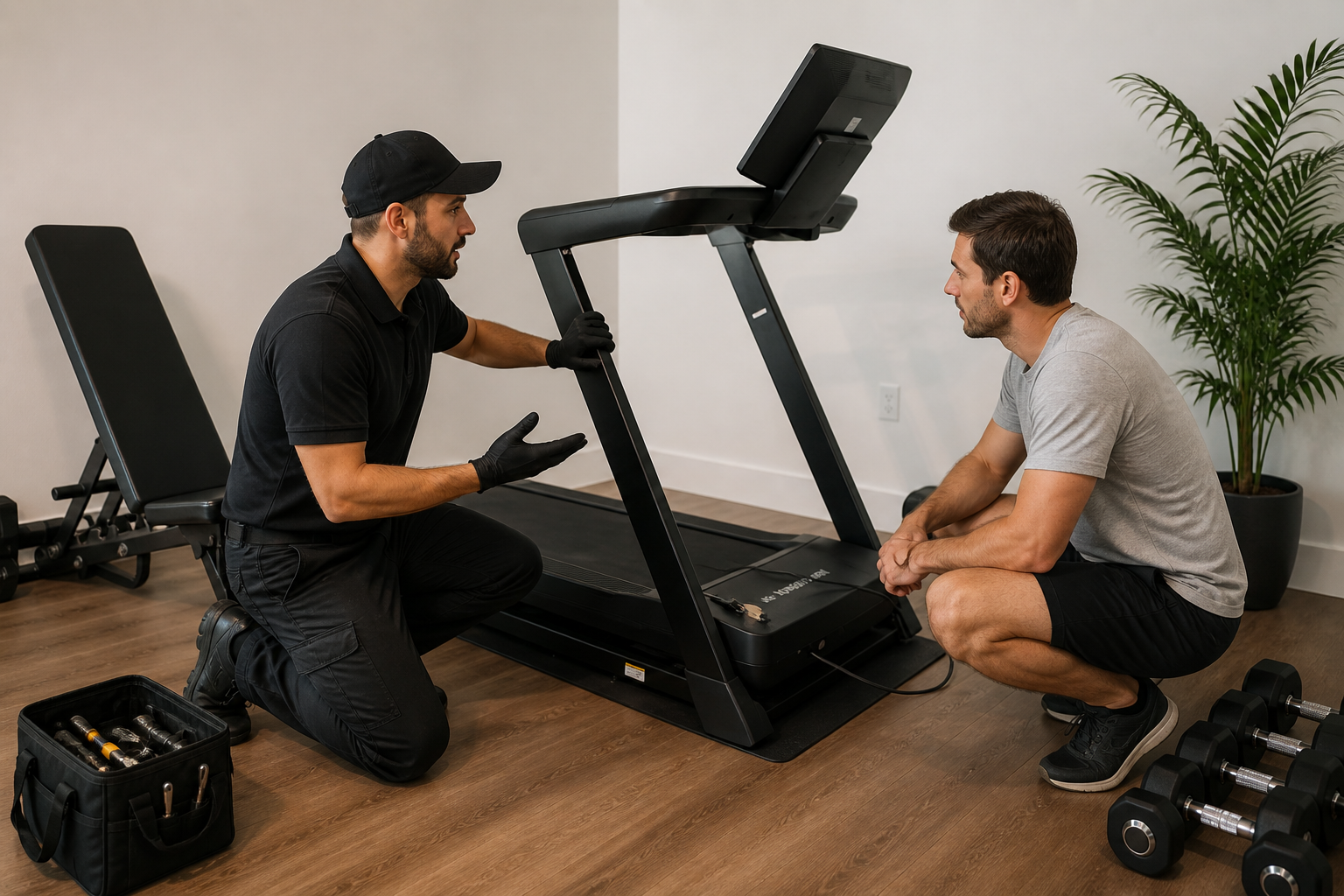

Elliptical repair in Dallas is one of the most common service calls we handle at 2EZ TEK, and the machines that come across our schedule range from budget-friendly ProForm units to high-end NordicTrack and Precor models sitting in home gyms across Frisco, Plano, Arlington, and everywhere in between. Whether your elliptical is grinding, drifting in resistance, throwing an error code, or just stopped working entirely, the problem almost always traces back to a handful of known failure points. This guide walks you through what those are, what not to do, and how to get it handled right.
Common Symptoms
- Grinding or clicking noise during stride: Usually happens at a consistent point in the pedal rotation. This points to a worn pedal arm bushing, a loose crank bolt, or debris caught near the flywheel or drive axle.
- Resistance not changing or stuck at one level: The machine moves fine but you cannot increase or decrease the workout intensity. This typically means the resistance magnet or eddy current brake system is not receiving a signal, or the motor controlling it has failed.
- Console displays error code or goes blank: Error codes like E1, E2, or LS on common brands indicate communication failures between the console and the motor control board, or a faulty reed switch not registering pedal movement.
- Wobbly or unstable feel during use: If the machine rocks side to side or the stride feels uneven, the leveling feet may be off, but more often a pedal link pin or roller wheel on the track has worn down.
- Incline not adjusting: On machines with power incline, the incline actuator motor can seize or strip internally, leaving the ramp locked at one angle.
- Squeaking from the handlebars or upper body arms: The pivot points on the upper arm assembly use plastic bushings that dry out over time. This is a lubrication or bushing replacement issue, not a structural failure.
- Machine powers on but pedals feel heavy or drag: This can mean the tension roller or brake pad is sitting too close to the flywheel, or the drive belt has stretched and is slipping under load.
Root Causes: What Is Actually Happening
- Worn or seized resistance magnet assembly: Most home ellipticals use an eddy current brake system where a resistance magnet moves closer to or farther from the flywheel to change difficulty. The small servo motor that drives this movement wears out, or the magnet carriage corrodes and binds on its rail. When this happens, the console sends a signal but nothing moves.
- Failed reed switch or speed sensor: The reed switch is a small magnetic sensor mounted near the flywheel. It counts rotations and sends that data to the motor control board so the console can display speed and calories. When the reed switch fails or the magnet on the flywheel shifts position, the console loses its reference signal and either freezes, throws an error, or shuts the machine down as a safety measure.
- Motor control board failure: The motor control board regulates power delivery to the resistance system and processes input from the console. Boards fail from power surges, heat buildup in enclosed spaces, and simple age. A failed board often presents as a machine that powers on but does not respond to any resistance or incline commands.
- Worn pedal link bushings and roller wheels: The pedal arms on an elliptical travel along a track using small roller wheels and pivot through bushings at the crank. Both wear down with use. When they go, you get noise, vibration, and an uneven stride. Replacing them is straightforward but requires disassembling the lower frame, which most homeowners understandably do not want to tackle.
- Drive belt stretch or misalignment: Some elliptical models use a drive belt between the crank and flywheel. Over time the belt stretches, loses tension, and begins slipping. If the belt is also misaligned on its pulleys, it will fray at the edges and eventually snap. A slipping belt feels like the machine is hesitating or surging during your stride.
- Console and wire harness issues: The wire harness running from the console down through the upper arms to the main frame flexes thousands of times during normal use. Individual wires inside the harness break at stress points near the pivot joints. This causes intermittent console behavior, including buttons that stop working, displays that flicker, or heart rate sensors that read incorrectly.
What NOT to Do
- Do not spray WD-40 on squeaking parts: WD-40 is a solvent, not a lubricant. Applying it to elliptical pivot points and bushings will temporarily quiet the noise but will strip away any remaining lubrication and accelerate wear. Use a silicone-based lubricant or the specific grease recommended by the manufacturer for plastic-on-metal contact points.
- Do not ignore an error code and keep using the machine: Error codes exist because a sensor or board has detected a condition outside normal operating parameters. Running through an error code, especially one related to the resistance system or speed sensor, can cause secondary damage to the motor control board or flywheel assembly that turns a simple repair into a much more expensive one.
- Do not assume the console is the problem: Consoles are often the first thing people blame because they are the most visible component. In our experience, the console itself is rarely the root cause. Replacing a console without diagnosing the underlying electrical or mechanical issue will not fix the machine and wastes money on a part you did not need.
- Do not overtighten crank bolts without checking the torque spec: If you hear clicking and try to fix it by tightening every bolt you can find, you risk stripping the threads in the crank arm or cracking the plastic housing around the axle. Crank bolts on ellipticals have specific torque values, and going past them causes damage that is harder to repair than the original noise.
Professional Elliptical Repair in Dallas Fort Worth
2EZ TEK has handled elliptical repairs across the entire Dallas Fort Worth metro, from McKinney and Allen in the north to Mansfield and Cedar Hill in the south. We work on all major residential brands including NordicTrack, ProForm, Sole, Precor, Bowflex, Schwinn, Life Fitness, and Horizon. With over 500 five-star reviews, our reputation is built on showing up when we say we will and diagnosing the actual problem instead of guessing at parts. Most repairs are scheduled within the same week of your call.
One thing that sets 2EZ TEK apart in this market is that we actively serve residential homeowners. Many repair companies in DFW focus exclusively on commercial gyms and fitness facilities, and they will turn away a homeowner with a single machine at home. We built our business around the opposite model. If you have an elliptical in your spare bedroom, garage gym, or living room in Dallas, Plano, Fort Worth, or anywhere in between, we will come to you. You do not need to haul the machine anywhere or deal with a company that treats your call as low priority.
We also carry a working inventory of common replacement parts for popular elliptical models, which means we can often complete the repair in a single visit rather than ordering parts and scheduling a second trip. That matters when you have a workout routine that depends on the machine being functional.
Frequently Asked Questions
How much does elliptical repair typically cost in Dallas?
Repair costs vary depending on what failed and which brand you own. A reed switch replacement or lubrication service on a standard residential elliptical is generally on the lower end of the repair cost range. A motor control board replacement or resistance magnet assembly on a higher-end machine will cost more. We provide a diagnosis and estimate before any work begins so you can decide whether repair makes sense for your specific machine and its age.
Is it worth repairing an older elliptical or should I just replace it?
This depends on the brand, the age, and what failed. A well-built machine from Precor, Life Fitness, or Sole with a failed reed switch or worn bushings is almost always worth repairing. A budget machine that is eight or more years old with a failed motor control board may cost more to fix than its current replacement value. We will give you an honest answer on this when we diagnose the machine. We are not in the business of recommending repairs that do not make financial sense for you.
Do I need to move the elliptical before the technician arrives?
No. We work on machines in place. Ellipticals are large and heavy, and most homeowners do not have a way to move them safely. We bring the tools needed to access components from whatever position the machine is in. If you have it against a wall, give us about two to three feet of clearance on the sides and rear if possible, but we can work around tight spaces.
Ready to Get It Fixed?
Contact 2EZ TEK today to schedule your elliptical repair in Dallas Fort Worth. We respond fast, diagnose accurately, and get your machine back in working order without the runaround.