
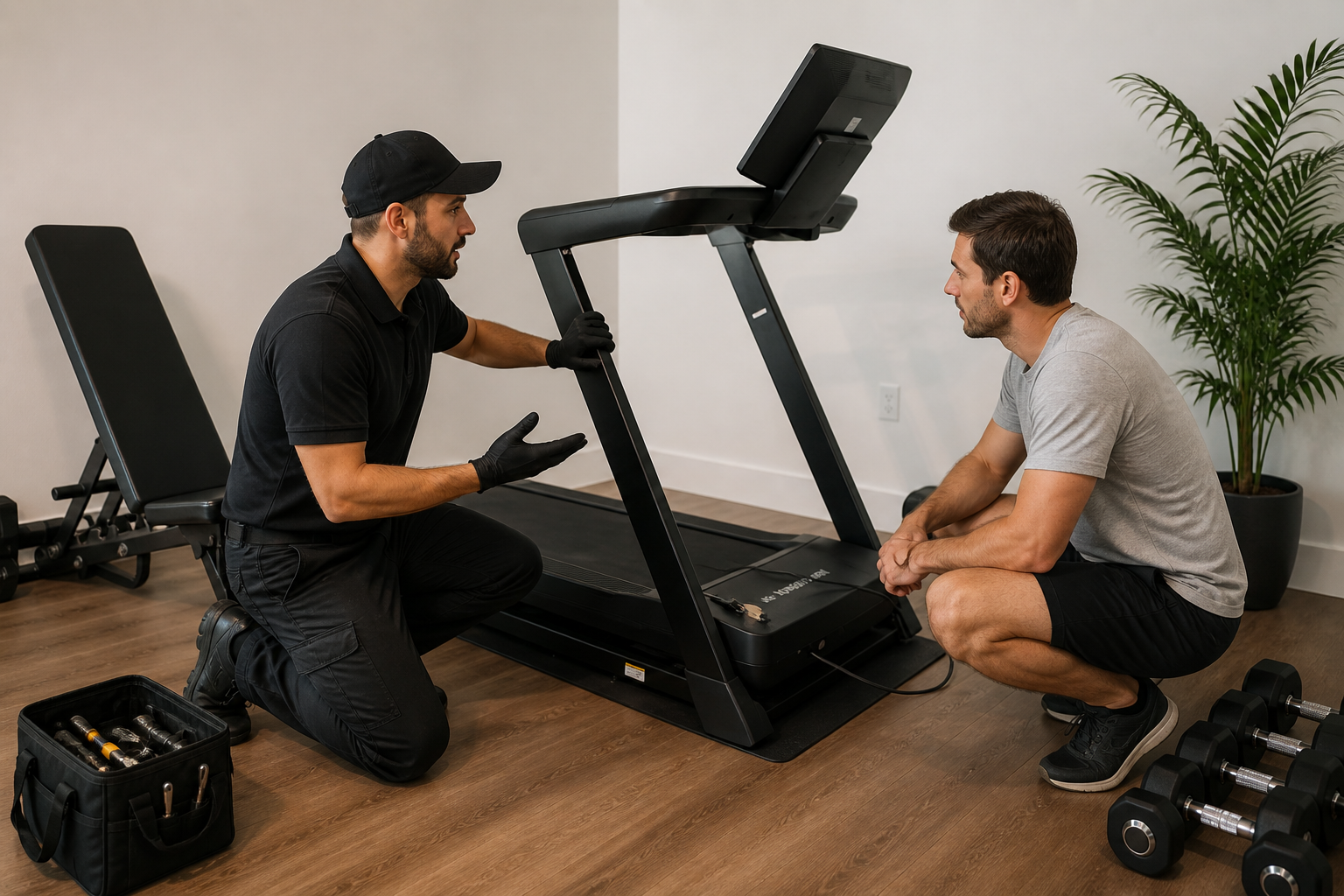

Elliptical machines are one of the most common repair calls we handle at 2EZ TEK in Dallas Fort Worth. When an elliptical starts grinding, skipping resistance levels, wobbling underfoot, or refusing to power on, the cause is rarely obvious from the outside. These machines run a flywheel, resistance magnets, drive linkage arms, roller wheels, and an electronic control system all at the same time. When one part starts to go, the symptoms can look like three different problems at once. This guide breaks down what is actually happening inside the machine, what mistakes to avoid, and when it makes sense to call a technician.
Common Symptoms
- Grinding or scraping noise during stride: Usually heard at a consistent point in the pedal rotation, this points to a worn or dry bearing in the flywheel hub, crank arm, or drive axle rather than a surface-level linkage issue.
- Resistance not changing: You press the resistance button and nothing happens, or the machine jumps straight to maximum resistance. This typically involves the eddy current brake system, the resistance motor, or a failed signal from the motor control board.
- Wobbling or unstable feel underfoot: The pedals rock side to side or the frame shifts during use. This usually means worn roller wheels, degraded linkage bushings, or a pedal arm that has cracked but not fully separated yet.
- Console powers on but machine does not respond: The display lights up, but stride tracking stops, resistance controls freeze, or the unit shuts down mid-workout. These intermittent failures almost always trace back to a failing motor control board or a loose wire harness connection.
- Squeaking with every stride: A rhythmic squeak that matches your pedal speed is a lubrication issue on the roller wheels, pivot points, or upper arm linkage hardware. It sounds minor but accelerates wear quickly if left alone.
- Error codes on the display: Codes like E1, E2, or E6 are the machine flagging a specific component failure. Common triggers include a failed reed switch, a resistance motor that is not responding, or a communication fault between the console and the motor control board.
- Pedals feel uneven or skip during stride: One side feels heavier or catches at a specific point in the rotation. This often points to a worn drive belt, a damaged tension roller, or uneven wear on the flywheel axle bearings.
Root Causes: What Is Actually Happening
- Worn flywheel bearings: The flywheel spins thousands of times per workout. Over time, the bearings that support the flywheel hub dry out or develop flat spots. When that happens, you get a grinding or rumbling noise that gets louder as the machine warms up. Replacing the bearings early prevents damage to the flywheel axle itself.
- Failed resistance magnet system: Most modern ellipticals use an eddy current brake, which moves a resistance magnet closer to or farther from the flywheel to change difficulty. The motor that drives this magnet can seize, the gear can strip, or the motor control board can stop sending the correct signal. All three failures produce the same symptom: resistance that is stuck or erratic.
- Degraded drive belt or tension roller: The drive belt transfers power from the pedal crank to the flywheel. Belts stretch, crack, or glaze over time, especially in machines that run in hot garages or home gyms without climate control. A worn tension roller stops maintaining proper belt contact, which causes skipping or uneven pedal feel.
- Reed switch failure: The reed switch is a small magnetic sensor that tracks flywheel rotation and sends speed data to the console. When it fails or drifts out of alignment, the console loses stride data, throws error codes, or shuts the machine down as a safety measure. It is a small part but it controls a lot of machine behavior.
- Motor control board failure: The motor control board manages resistance changes, console communication, and power delivery to the drive system. Heat, power surges, and age all degrade the board over time. A failing board produces symptoms that look random, including mid-workout shutdowns, frozen controls, and error codes that clear and return without explanation.
- Worn linkage bushings and roller wheels: The upper and lower linkage arms connect through bushings and ride on roller wheels along a track. When these wear out, the stride feels loose, the machine wobbles, and metal-on-metal contact begins. Left unaddressed, worn bushings accelerate damage to the linkage arms themselves.
What NOT to Do
- Do not spray WD-40 on squeaking parts: WD-40 is a solvent, not a lubricant. Applying it to roller wheels, pivot points, or linkage hardware strips away existing grease and leaves the metal dry within a few days. Use a silicone-based lubricant or a grease rated for fitness equipment instead.
- Do not keep using the machine when you hear grinding: A grinding noise means metal is contacting metal somewhere it should not be. Continuing to use the elliptical accelerates bearing damage, can score the flywheel axle, and turns a straightforward bearing replacement into a much more expensive repair.
- Do not reset error codes without diagnosing the cause: Clearing an error code from the console does not fix the underlying problem. The code will return, often with additional damage, because the root cause is still active. Error codes exist to protect the machine from running in a failed state.
- Do not assume the console is the problem: When an elliptical behaves erratically, most people assume the display or console is faulty. In most cases, the console is fine and the problem is in the motor control board, reed switch, or a wiring connection behind the frame. Replacing the console first is an expensive mistake that leaves the real problem in place.
Professional Repair in Dallas Fort Worth
At 2EZ TEK, elliptical repair is one of our most frequent service calls across Dallas Fort Worth. We carry parts for the brands that show up most often in local homes and gyms, including NordicTrack, ProForm, Precor, Life Fitness, Bowflex, and Sole. Our technicians have seen every failure mode described in this guide, and most repairs are completed in a single visit without waiting on parts to ship from a manufacturer warehouse.
We have earned over 500 five-star reviews from customers across the Dallas Fort Worth area, and we back that reputation with fast scheduling and honest diagnostics. We do not quote repairs over the phone without seeing the machine, because the same symptom can have three different causes depending on the brand and model. What we do promise is a clear explanation of what is wrong, what it will cost, and whether repair makes more sense than replacement for your specific machine.
Same-week service is available for most locations in Dallas Fort Worth. We come to your home or facility, diagnose the machine on-site, and complete the repair the same visit whenever parts are on hand. No hauling the machine to a shop, no waiting weeks for a callback from a national chain.
Frequently Asked Questions
How much does elliptical repair cost in Dallas?
Repair costs vary depending on the part that has failed and the brand of machine. A reed switch replacement or lubrication service runs on the lower end. A motor control board or resistance motor replacement costs more, but is still significantly less than buying a new machine in most cases. We provide a firm quote after diagnosing the machine on-site, so there are no surprises on the final bill.
Is it worth repairing an older elliptical?
In most cases, yes. Ellipticals are built around a heavy steel frame and flywheel that last for decades. The parts that fail are the electronics, bearings, belts, and rollers, all of which are replaceable. If the frame is intact and the machine is from a reputable brand, repair is almost always the better financial decision compared to buying new.
My elliptical makes noise only at one point in the stride. What does that mean?
A noise that occurs at a specific point in the pedal rotation is almost always mechanical rather than electrical. The most common causes are a worn crank arm bearing, a flat spot on a roller wheel, or a loose linkage connection that only loads up at a certain angle. This kind of noise is easy to diagnose in person and usually straightforward to fix once the source is confirmed.
Get It Fixed This Week
If your elliptical is grinding, skipping, wobbling, or throwing error codes, contact 2EZ TEK today and we will get a technician to your Dallas Fort Worth location this week to diagnose and repair it on-site.