
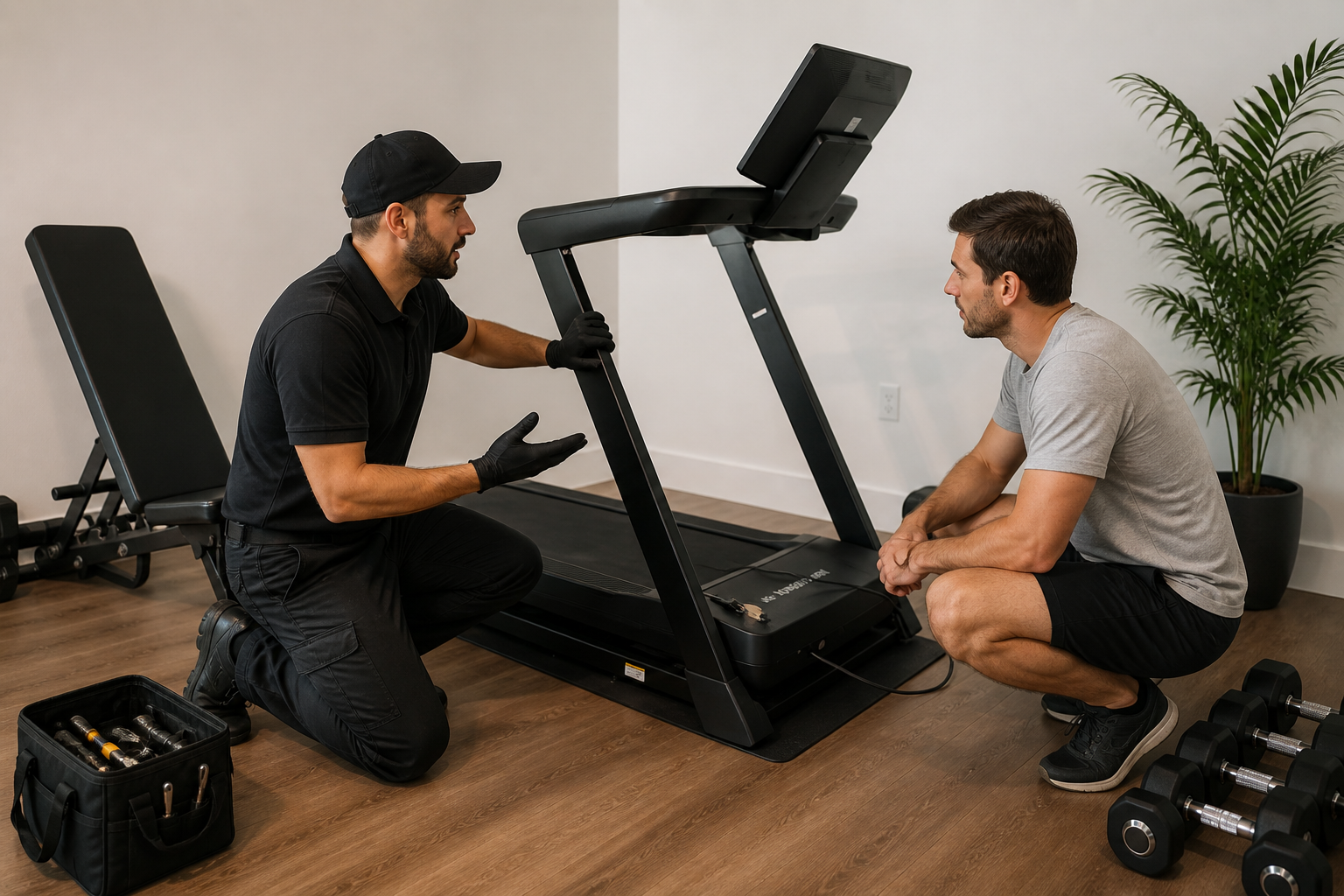

Elliptical repair in Dallas is one of the most common service calls we handle at 2EZ TEK, and most machines fail for the same handful of reasons. Whether your elliptical is grinding, squeaking, throwing error codes, or just stopped working entirely, this guide will walk you through what is actually happening inside the machine and what it takes to get it running again. We service all major residential elliptical brands across Dallas Fort Worth, and we have seen these problems hundreds of times.
Common Symptoms
- Grinding or crunching noise during stride: Usually comes from worn roller wheels, a dry pivot bushing, or a damaged flywheel bearing. The noise often gets louder as the machine warms up.
- Resistance not changing: When you press the resistance buttons and nothing happens, the eddy current brake or resistance magnet has likely failed, or the motor control board is not sending the correct signal.
- Console shows E1, E2, or similar error codes: These codes point to communication failures between the console and the drive system, often caused by a faulty reed switch or a broken magnet on the flywheel.
- Wobbly or unstable stride: Loose pedal arms, worn pivot pins, or a cracked frame weld can all cause the machine to rock or shift under load.
- Incline not responding: On power incline models, a failed incline actuator or a stripped drive gear is usually the culprit. You may hear a clicking or humming with no movement.
- Console is dead or flickering: A failed power supply, a loose wire harness connection, or a bad motor control board can all kill the display.
- Squeaking on every stride: Dry pivot points, worn pedal link bearings, or an unlubricated drive system create rhythmic squeaks that match your foot strike.
Root Causes: What Is Actually Happening
- Worn or seized roller wheels: Most ellipticals use plastic or polyurethane roller wheels that ride along a curved track. Over time, the bearings inside these wheels wear out or seize from lack of lubrication. Once a roller stops spinning freely, it drags across the track and creates that grinding sound you hear with every stride.
- Failed reed switch or flywheel magnet: The reed switch is a small magnetic sensor mounted near the flywheel. It counts rotations and sends speed data to the console. If the reed switch fails or the small magnet attached to the flywheel cracks or falls off, the console loses its signal and throws error codes. This is one of the most common electronic failures we see on mid-range home ellipticals.
- Degraded eddy current brake or resistance magnet assembly: Magnetic resistance ellipticals use an eddy current brake to create drag on the flywheel. The resistance magnet moves closer to or farther from the flywheel to increase or decrease resistance. When the servo motor driving that magnet fails, or when the control board stops sending voltage to it, resistance locks at one level or stops working entirely.
- Dry or corroded pivot bushings and bearings: Ellipticals have multiple pivot points where the pedal arms, handlebars, and linkage rods connect. These joints use bushings or sealed bearings that dry out over years of use. Once the lubrication is gone, metal grinds on metal, which creates noise and accelerates wear on the surrounding hardware.
- Faulty motor control board: On motorized incline or powered resistance models, the motor control board regulates voltage to the drive components. Heat cycles, power surges, and age cause capacitors and transistors on the board to fail. A bad board can cause total power loss, erratic resistance behavior, or incline actuator faults all at once.
- Loose or cracked frame welds: Heavy use and improper storage can stress the welds at the pedal arm connection points and the main frame joints. A cracked weld creates flex and instability during use. Left unaddressed, it can cause catastrophic frame failure mid-workout.
What NOT to Do
- Do not spray WD-40 on roller wheels or bearings: WD-40 is a solvent, not a lubricant. It will temporarily quiet a squeaky joint but it strips away whatever grease remains and leaves the metal dry within days. Use a proper silicone-based lubricant or lithium grease for elliptical pivot points.
- Do not keep using the machine when you hear grinding: Grinding means metal or plastic is being destroyed with every stride. Running the elliptical through the noise turns a simple roller wheel replacement into a full track replacement or frame repair. Stop using it and get a technician out.
- Do not reset error codes without diagnosing the cause: Clearing an E1 or E2 code from the console without finding the failed component just delays the diagnosis. The code will return, and in some cases, running a machine with an unresolved sensor fault can damage the motor control board.
- Do not overtighten pedal arm bolts without checking the bushing: If a pedal feels loose, the instinct is to crank down the bolt. But if the bushing inside the pivot is worn, tightening the bolt just compresses a damaged part and can crack the pedal arm casting. Replace the bushing first, then torque the bolt to spec.
Professional Elliptical Repair in Dallas Fort Worth
2EZ TEK has earned over 500 five-star reviews from customers across Dallas Fort Worth, and the reason is straightforward. We show up, we diagnose the actual problem, and we fix it correctly the first time. Most of our elliptical repairs are completed within the same week you call. We carry common replacement parts for the brands we service most, including NordicTrack, ProForm, Sole, Precor, Life Fitness, Bowflex, Horizon, and Schwinn, which means fewer delays waiting on parts to ship.
One thing that sets 2EZ TEK apart in the DFW market is that we actively serve residential homeowners. Many of our competitors focus exclusively on commercial gyms, apartment complexes, and corporate fitness centers. If you call a national franchise repair service with a machine in your home, there is a real chance they will turn you away or push you to the back of the schedule. We built our business around homeowners in Dallas, Plano, Frisco, Arlington, and the surrounding areas. Your home elliptical gets the same attention and the same quality of repair as any commercial account.
We also do not charge you for a diagnosis and then hand you a quote that assumes the worst-case scenario. We tell you what is wrong, what it costs to fix, and what the machine will realistically need over the next year. If a repair does not make financial sense given the age and condition of the machine, we will tell you that too. That kind of honesty is why customers in DFW keep calling us back.
Frequently Asked Questions
How much does elliptical repair typically cost in Dallas?
Most residential elliptical repairs fall between $150 and $400 depending on the failed component. A reed switch replacement is on the lower end. A motor control board or incline actuator replacement runs higher. We give you a firm quote before any work begins, so there are no surprises on the final invoice.
Is it worth repairing an older elliptical, or should I just replace it?
It depends on the machine. A well-built elliptical from a brand like Precor or Sole is worth repairing even at 8 to 10 years old because the frame and drive system are designed to last. A budget machine that cost $400 new and needs a $300 repair is usually not worth fixing. When you call us, we will give you an honest assessment based on what we find during the diagnosis.
How long does a typical elliptical repair appointment take?
Most repairs are completed in one visit that runs one to two hours. If we need to order a specific part, we schedule a follow-up once it arrives, usually within a few days. We do not leave machines torn apart waiting on parts for weeks. We communicate the timeline clearly from the start.
Ready to Get It Fixed?
Contact 2EZ TEK today to schedule your elliptical repair in Dallas Fort Worth and get your machine back in working order this week.