
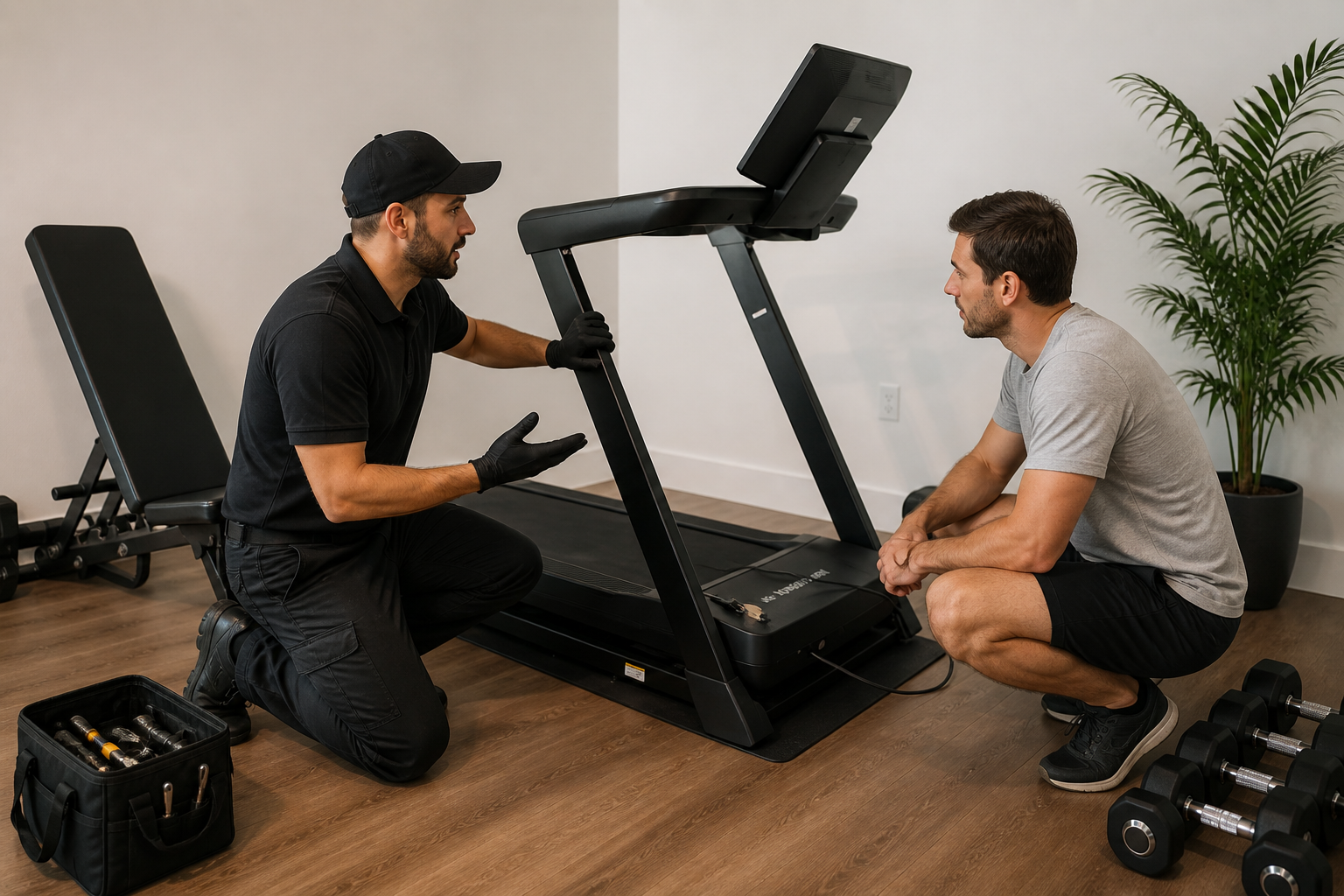

Elliptical repair in Dallas is one of the most common service calls we get at 2EZ TEK, and most of the time the machine is not as far gone as the owner thinks. Whether your elliptical is grinding, clicking, losing resistance, or just refusing to power on, the problem usually traces back to a handful of known failure points. This guide walks you through what those are, what is actually happening inside the machine, and what you should avoid doing before a technician arrives.
Common Symptoms
- Grinding or clicking noise with each stride: Usually heard at the bottom of the pedal stroke. This almost always points to worn pedal arm bushings, a dry pivot bolt, or a failing flywheel bearing that has lost its lubrication.
- Resistance not changing or stuck at one level: The machine moves fine but the resistance magnet or eddy current brake is not responding to console commands. Could be a failed motor control board signal or a disconnected resistance motor.
- Console shows no power or partial display: The screen flickers, shows dashes, or stays completely dark. This is often a failed power supply, a loose wire harness at the console, or a dead motor control board.
- Incline not working: The ramp stays flat or gets stuck mid-adjustment. The incline actuator motor is the usual suspect, though a stripped drive gear or a failed reed switch can produce the same symptom.
- Wobbly or unstable stride feel: The machine rocks side to side or the pedals feel loose. Worn stride linkage bushings or loose frame bolts are almost always the cause.
- Error codes on the console: Codes like E1, E2, or E6 point to specific component failures depending on the brand. These are not random glitches. They are the machine telling you exactly where to look.
- Belt slipping or skipping: Some ellipticals use a drive belt connecting the flywheel to the resistance system. When that belt stretches or cracks, the stride feels inconsistent and you may hear a slapping sound.
Root Causes: What Is Actually Happening
- Worn or dry pivot bushings and bearings: Every elliptical has multiple pivot points where the pedal arms, linkage rods, and crank arms rotate against each other. These joints use plastic or bronze bushings that wear down over time, especially without periodic lubrication. Once the bushing material wears away, metal contacts metal and you get that familiar grinding or clicking sound on every stride.
- Failed resistance magnet or eddy current brake assembly: Most modern ellipticals use a magnetic resistance system where a resistance magnet moves closer to or farther from the flywheel to increase or decrease drag. The motor that positions this magnet can fail, the worm gear inside it can strip, or the control signal from the motor control board can drop out entirely. When any of these fail, the resistance either locks in place or disappears completely.
- Motor control board failure: The motor control board is the central processing unit for all electronic functions including resistance control, incline, and console communication. Heat, power surges, and simple age cause capacitors and transistors on the board to fail. A bad board can produce symptoms that look like multiple separate problems, which is why diagnosis before parts replacement matters.
- Incline actuator motor failure: The incline actuator is a small linear motor that physically raises and lowers the front ramp. These motors are reliable but they do fail, especially on machines that are used frequently at higher incline settings. The actuator can also lose its calibration, causing it to hit the travel limit and trigger a fault code even when the ramp looks fine.
- Loose or cracked stride linkage hardware: The stride linkage connects the pedal arms to the flywheel crank. Over thousands of cycles, the bolts at these connection points can back out, and the plastic or nylon bushings at each joint wear thin. A loose linkage bolt is a safety issue, not just a noise issue, because it can cause the pedal to shift unexpectedly mid-stride.
- Reed switch misalignment or failure: Many ellipticals use a reed switch to track RPM and send speed data to the console. This small magnetic sensor sits near a magnet mounted on the flywheel. If the gap between the reed switch and the magnet drifts even a few millimeters, the console loses its speed reading and may display an error or show zero miles per hour even while you are actively using the machine.
What NOT to Do
- Do not spray WD-40 on squeaking joints: WD-40 is a solvent and a water displacer, not a lubricant. Applying it to elliptical pivot points and bushings will temporarily quiet the noise but it will flush out whatever grease remains and accelerate wear. Use a lithium-based grease or a silicone spray rated for fitness equipment instead.
- Do not keep using the machine when you hear grinding: Metal-on-metal contact inside a flywheel bearing or a worn bushing gets worse with every stride. What starts as a fixable bearing swap can turn into a damaged flywheel housing or a bent crank arm if you put another few hundred miles on it before calling a technician.
- Do not replace the motor control board before testing the power supply: Motor control boards for name-brand ellipticals can run $150 to $400. A failed power supply or a blown fuse can produce identical symptoms for a fraction of the cost. Replacing the board first without testing is an expensive guess.
- Do not overtighten stride linkage bolts without checking bushing condition first: If a linkage bolt is loose, the instinct is to crank it down. But if the bushing inside the joint is already worn, tightening the bolt just crushes what is left of the bushing and locks up the joint. Replace the bushing, then torque the bolt to spec.
Professional Elliptical Repair in Dallas Fort Worth
2EZ TEK has handled elliptical repairs across Dallas Fort Worth for years, and one thing that sets us apart from the national franchise repair companies is that we actually show up for residential customers. A lot of the bigger competitors in DFW focus exclusively on commercial gyms and corporate fitness centers. If you have a NordicTrack, Bowflex, ProForm, Sole, or Precor elliptical sitting in your spare bedroom or garage, many of those services will not return your call. We built our business around exactly that customer, the homeowner who paid good money for a machine and just wants it working again.
We carry parts and service experience across all major residential elliptical brands including NordicTrack, ProForm, Sole, Bowflex, Schwinn, Horizon, and Precor. Our technicians diagnose before they quote, which means you are not paying for a board replacement when the real problem is a $30 reed switch. With over 500 five-star reviews from customers across the Metroplex, our reputation is built on showing up fast, diagnosing accurately, and fixing it right the first time. We offer same-week service scheduling throughout Dallas Fort Worth.
If you have gotten quotes from other companies that seem high or vague, give us a call. We will tell you straight whether the repair makes financial sense or whether the machine has reached the end of its useful life. That kind of honest answer is something a lot of customers tell us they could not get anywhere else in DFW.
Frequently Asked Questions
How much does elliptical repair typically cost in Dallas?
Most residential elliptical repairs in the Dallas area fall between $100 and $350 depending on what failed. A reed switch or lubrication service is on the lower end. A motor control board or resistance motor replacement sits at the higher end. We give you a firm quote after diagnosis, not before, so you know exactly what you are paying for before any work begins.
Is it worth repairing an older elliptical or should I just buy a new one?
That depends on the machine and the failure. A 10-year-old entry-level elliptical with a cracked frame or a discontinued motor control board may not be worth repairing. But a mid-range or high-end machine from Sole, Precor, or NordicTrack with a worn bushing or a failed resistance motor is almost always worth fixing. The repair cost is usually a fraction of replacement, and the mechanical structure of a well-built elliptical lasts a long time. We will give you an honest assessment when we look at it.
Can I get same-week service for my home elliptical in Dallas?
Yes. We schedule residential elliptical repairs throughout Dallas Fort Worth on a same-week basis in most cases. We know your machine is sitting unused and you want it back. When you contact us, we will get you on the schedule quickly and confirm a window that works for you.
Ready to Get It Fixed?
Contact 2EZ TEK today to schedule your elliptical repair in Dallas. We will diagnose the problem, give you a straight quote, and get your machine back up and running this week.