
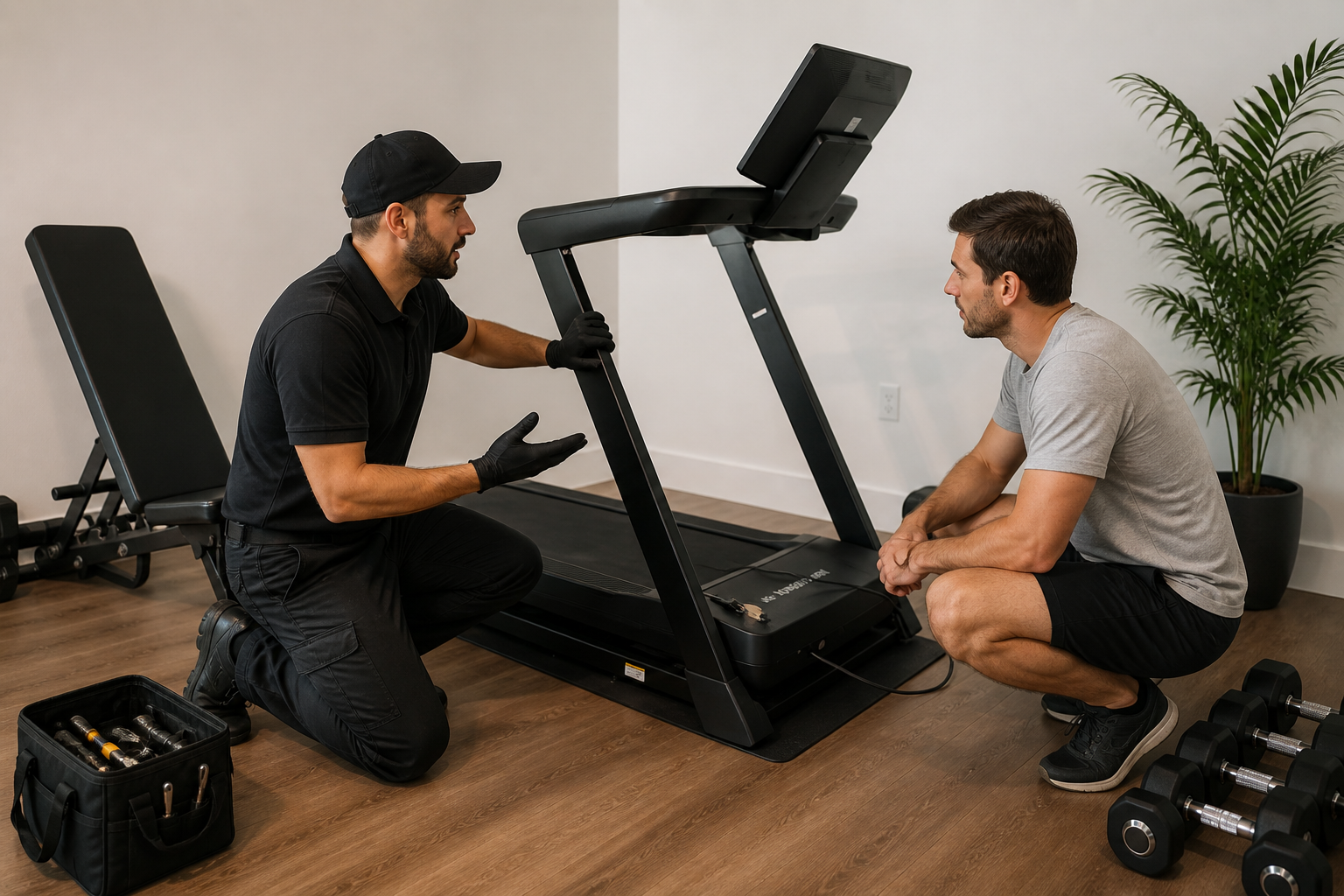

Exercise bike repair in Dallas covers a wide range of problems, from a stationary bike that pedals with zero resistance to a spin bike that grinds, squeaks, or shuts off mid-ride. Whether you own an upright, recumbent, or indoor cycling bike, the mechanical and electronic components inside these machines fail in predictable ways. This guide walks you through the real symptoms, the actual causes, and what to do before you call a technician.
Common Symptoms
- Resistance that will not change or feels the same at every level: The bike accepts input from the console but the pedaling effort never varies. This usually points to a failed resistance magnet, a broken eddy current brake assembly, or a disconnected control cable.
- Grinding or scraping noise while pedaling: A rhythmic grinding that matches your pedal stroke almost always comes from the flywheel, a worn bottom bracket, or debris caught between the resistance magnet and the flywheel surface.
- Console powers on but the bike does not respond to resistance adjustments: The display works, but pressing the resistance buttons does nothing. The motor control board or the resistance motor itself has likely failed.
- Pedals feel loose or wobble during use: Loose crank arms, a worn pedal spindle, or a stripped crank bolt cause this. Riding through it will damage the crank arm threads and turn a simple fix into a parts replacement job.
- Console is blank or shows an error code: No power to the display usually means a failed power supply, a tripped surge protector, or a bad reed switch that prevents the console from initializing.
- Bike stops mid-workout and restarts on its own: Intermittent shutdowns on electronic bikes often trace back to an overheating motor control board, a loose wire harness connection, or a failing power adapter.
- Squeaking that gets worse over time: A squeak that started quiet and is now loud is usually a dry or worn tension roller, a loose belt, or a pedal bearing that needs lubrication or replacement.
Root Causes: What Is Actually Happening
- Worn or misaligned resistance magnet: Most modern upright and recumbent bikes use an eddy current brake system. A permanent magnet moves closer to or farther from the flywheel to increase or decrease resistance. When the magnet bracket bends, the magnet housing cracks, or the servo motor driving the magnet fails, you lose all resistance control. The flywheel itself is usually fine, but the magnet assembly needs replacement or realignment.
- Failed reed switch: The reed switch is a small magnetic sensor mounted near the flywheel that tells the console how fast you are pedaling. When it fails, the console cannot calculate speed, distance, or calories, and some bikes will not allow resistance changes without a valid speed signal. Reed switches are inexpensive but require disassembly to access and test properly.
- Drive belt wear or slippage: Unlike treadmills that use a walking belt, exercise bikes use a narrow drive belt or chain to transfer power from the pedal crank to the flywheel. Over time, the belt stretches, glazes, or develops cracks. A slipping belt feels like the resistance suddenly drops during hard efforts. A broken belt means the pedals spin freely with no load at all.
- Motor control board failure on electronic resistance bikes: Bikes with motorized resistance systems rely on a motor control board to translate console commands into physical magnet movement. Heat, power surges, and age degrade the board's capacitors and solder joints. When the board fails, resistance locks at one level or becomes completely unresponsive. Replacing the board requires matching the exact part number to your model.
- Bottom bracket and crank bearing wear: The bottom bracket sits at the center of the pedal crank system and contains bearings that allow smooth rotation under load. On bikes used daily, these bearings wear out within a few years. The symptom is a clicking or grinding noise that appears at the same point in every pedal revolution. Ignoring it long enough will damage the crank spindle and the frame threads.
- Loose or frayed internal wiring: Exercise bikes flex slightly during use, and the wire harnesses connecting the console to the resistance motor and sensors work loose over time. A partially disconnected connector causes intermittent errors that are hard to diagnose without physically tracing each connection. This is one of the most common causes of random shutdowns and error codes on bikes that are two to five years old.
What NOT to Do
- Do not spray WD-40 on squeaking parts: WD-40 is a solvent and water displacer, not a lubricant. Spraying it on bearings, the drive belt, or the flywheel shaft will wash out the existing grease, cause rubber components to swell, and make the squeak return faster and louder. Use a dry silicone spray or the specific grease recommended in your owner's manual.
- Do not keep riding a bike with a loose crank arm: A crank arm that wobbles even slightly is stripping the interface between the arm and the spindle every time you pedal. What starts as a simple bolt tightening job becomes a full crank replacement once the taper or spline is damaged. Stop using the bike and get it looked at.
- Do not assume the console is the problem just because the display is blank: Replacing a console is expensive and often unnecessary. A blank display is more commonly caused by a tripped circuit breaker, a failed power adapter, or a bad reed switch preventing initialization. Buying a new console without diagnosing the actual cause wastes money and leaves the real problem in place.
- Do not force resistance adjustments when the system is not responding: Repeatedly pressing resistance buttons on a bike with a failed motor control board or jammed magnet actuator can burn out the servo motor or strip the actuator gears. If the resistance is not responding, stop adjusting and have the system diagnosed before riding further.
Professional Exercise Bike Repair in Dallas Fort Worth
2EZ TEK has handled exercise bike repairs across Dallas Fort Worth for years, and we have seen every failure mode described above on bikes from NordicTrack, Peloton, Schwinn, Life Fitness, Precor, Bowflex, and Sunny Health and Fitness. We carry common replacement parts including drive belts, reed switches, resistance magnets, and motor control boards, which means most repairs get done in a single visit without waiting weeks for a part to ship.
One thing that sets 2EZ TEK apart from the national franchise repair companies operating in DFW is that we actively serve residential homeowners. Many of our competitors focus exclusively on commercial gyms and fitness facilities, and they will turn away a homeowner with a single bike at home. That is not how we operate. The majority of our clients are people with one machine in their garage or spare bedroom who just need it working again. We treat those jobs with the same priority as any commercial account, and our 500-plus five-star reviews reflect that. We offer same-week service across the Dallas Fort Worth area so you are not waiting through multiple weekends with a broken bike sitting in the corner.
Booking with a local independent technician also means you get a direct answer from someone who has physically worked on your brand of bike, not a call center reading from a script. When you describe the symptom, we can usually tell you within a few minutes whether it is a belt, a board, a sensor, or something mechanical, and we give you a straight answer on cost before we start the work.
Frequently Asked Questions
How much does exercise bike repair typically cost in Dallas?
Most exercise bike repairs in the Dallas area fall between $75 and $250 depending on the part and the labor involved. A reed switch replacement or belt swap is on the lower end. A motor control board replacement or a full bottom bracket service runs higher. We give you a firm quote before starting any work so there are no surprises on the invoice.
Is it worth repairing an older exercise bike or should I just buy a new one?
For most bikes that are three to eight years old, repair makes financial sense. A new mid-range upright or recumbent bike costs $400 to $900, and a quality indoor cycling bike runs $600 to $1,500 or more. If the repair is under half the replacement cost and the frame is structurally sound, fixing it is almost always the better value. We will tell you honestly if a bike is not worth repairing rather than push you toward an unnecessary service call.
Do you repair Peloton bikes in Dallas?
Yes. We service Peloton bikes including resistance system issues, touchscreen problems, and mechanical wear on the crank and pedal assembly. Peloton's own service options can involve long wait times and high costs. We offer a faster alternative for Dallas Fort Worth homeowners who need their Peloton back in service without the extended scheduling delays.
Ready to Get It Fixed?
Contact 2EZ TEK today to schedule your exercise bike repair in Dallas Fort Worth. We will get a technician out to you this week and have you back on the bike as fast as possible.