
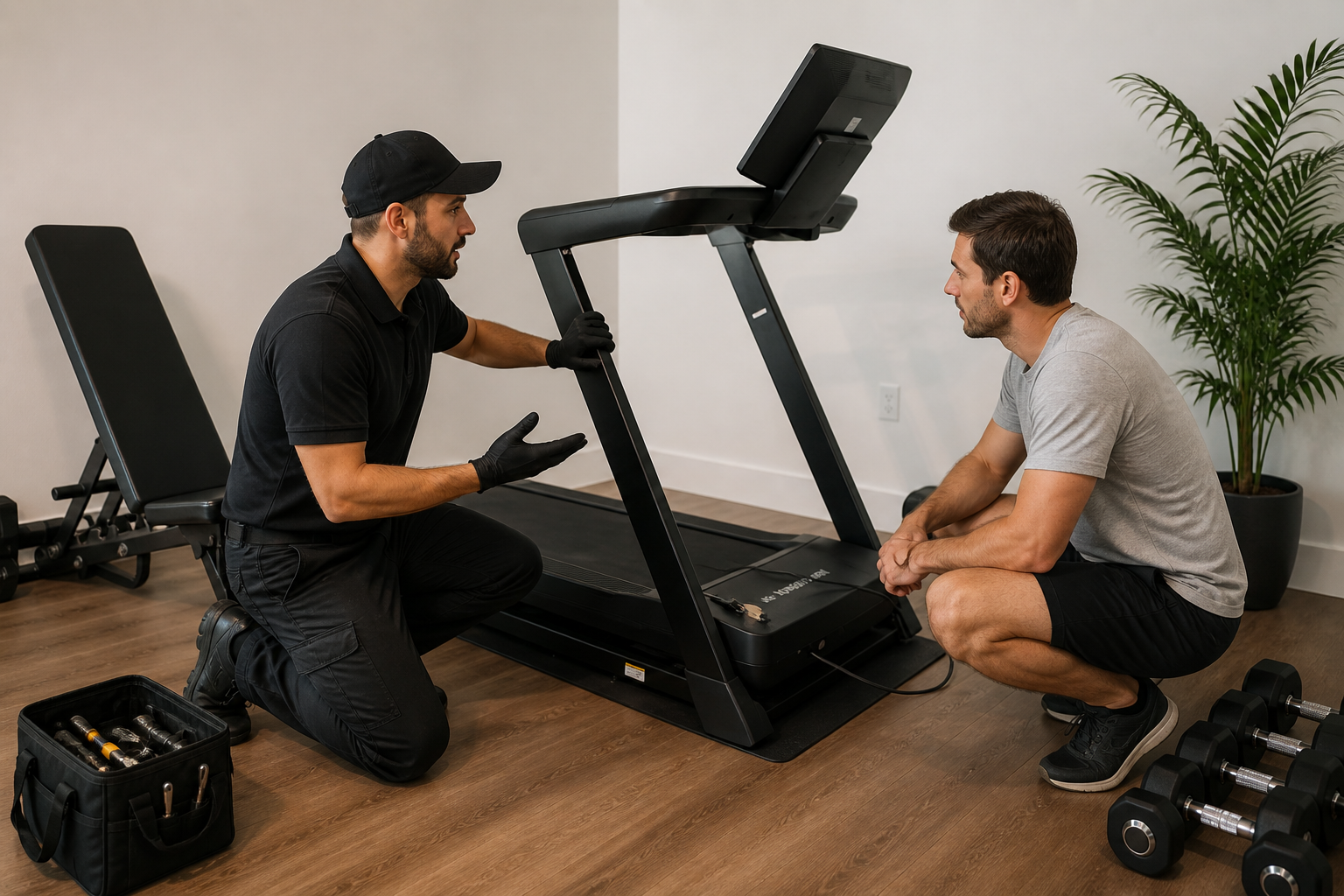

Gym equipment repair in Dallas Fort Worth covers everything from a treadmill walking belt that slips under load to an elliptical resistance magnet that stopped responding mid-workout. Whether your machine is in a spare bedroom in Frisco or a garage gym in Fort Worth, the failure patterns are consistent and the fixes are straightforward when you know what you are looking at. This guide gives you the real information so you understand what is happening before you call anyone.
Common Symptoms
- Walking belt slipping or hesitating: The belt loses grip when you step on it, especially at higher speeds. This usually happens under load and feels like the floor dropping out briefly beneath your feet.
- Treadmill shuts off mid-use: The machine powers down without warning, sometimes after 10 to 15 minutes of use. This points to a thermal overload on the drive motor or a failing motor control board.
- Elliptical resistance not changing: You press the resistance button and nothing happens, or the resistance jumps erratically. The eddy current brake or the resistance magnet assembly is usually involved.
- Loud grinding or squeaking noise: A rhythmic noise that matches your stride often comes from a dry tension roller, a worn drive belt, or debris caught in the flywheel housing.
- Incline not moving or stuck at one angle: The incline actuator motor runs but the deck does not move, or the machine throws an incline error code on the console.
- Console display is blank or flickering: The screen does not power on or cuts in and out. This can be a loose wiring harness, a failed console board, or a power supply issue upstream.
- Speed reads zero or jumps randomly: The console shows no speed or wildly incorrect numbers. The reed switch or magnetic speed sensor is the first place to check on most treadmill platforms.
Root Causes: What Is Actually Happening
- Walking belt wear and improper lubrication: The walking belt runs on a phenolic deck and requires silicone lubricant applied underneath at regular intervals. When that lubrication dries out, friction increases dramatically, the drive motor works harder than it was designed to, and the belt surface glazes over. A glazed belt will slip even after you re-lubricate it because the texture is gone.
- Motor control board failure: The motor control board regulates DC voltage to the drive motor. In residential machines, these boards are often undersized for the way people actually use them, meaning long daily sessions at high incline. Heat cycles cause solder joints to crack and capacitors to fail, which produces the random shutoff and inconsistent speed symptoms you see most often.
- Reed switch misalignment or failure: The reed switch sits near a magnet mounted on the front roller and pulses a signal to the console to calculate speed. Vibration shifts the switch out of position over time. When the gap between the magnet and the switch is too wide, the signal drops out and the console either reads zero or throws an error code.
- Incline actuator mechanical binding: The incline actuator is a small linear motor that raises and lowers the treadmill deck. The lead screw inside the actuator collects dust and debris, especially in garage environments common across DFW. When the screw binds, the actuator motor stalls and the control system interprets that as a fault, locking the incline in place.
- Eddy current brake drift on ellipticals: Elliptical resistance systems use a resistance magnet that moves closer to or farther from the flywheel to increase or decrease drag. The servo motor that positions this magnet wears out, or the magnet carriage track corrodes. When that happens, resistance levels become inconsistent or the machine defaults to maximum resistance and stays there.
- Drive belt stretching or cracking: The drive belt connects the motor pulley to the front roller on a treadmill, or transfers power through the elliptical drivetrain. Belts stretch with age and eventually slip on the pulleys, producing noise and erratic performance. In Texas heat, belts stored in garages degrade faster than the manufacturer's expected service life.
What NOT to Do
- Do not spray WD-40 on the walking belt: WD-40 is a solvent and a water displacer, not a lubricant. Applying it to a treadmill belt breaks down the belt material, contaminates the deck surface, and accelerates wear on both components. Use only 100 percent silicone lubricant formulated for treadmills.
- Do not keep running a slipping belt: Every minute you run on a belt that is slipping, you are pulling excess amperage through the drive motor and the motor control board. What starts as a 40-dollar belt lubrication job can turn into a 300-dollar board replacement if you ignore it long enough.
- Do not reset error codes without diagnosing the cause: Most treadmill and elliptical consoles will clear an error code if you unplug the machine and plug it back in. That does not fix anything. The underlying fault is still present, and repeated resets without repair often lead to cascading failures in the control system.
- Do not overtighten the walking belt: A common DIY fix attempt is cranking the rear roller bolts to stop a slipping belt. An overtightened belt puts extreme side load on the front and rear roller bearings and on the drive motor shaft. Bearing failure from over-tensioning is one of the more expensive repairs we see, and it is entirely avoidable.
Professional Gym Equipment Repair in Dallas Fort Worth
2EZ TEK has completed over 500 five-star reviewed repairs across the Dallas Fort Worth metroplex, covering everything from basic treadmill belt replacements to full motor control board swaps on commercial-grade machines. We carry parts for the brands that actually show up in DFW homes and facilities: NordicTrack, ProForm, Peloton, Life Fitness, Precor, Bowflex, Sole, Horizon, and Technogym. Same-week scheduling is standard, not a premium add-on, and we show up with the diagnostic tools and replacement parts to handle most repairs in a single visit.
One thing that sets 2EZ TEK apart in this market is that we actively serve residential clients. A large number of repair companies in DFW focus exclusively on commercial gyms and health clubs, and they will turn away a homeowner with a broken treadmill in their living room. We built our business around the opposite model. Most of our customers are people who invested in home gym equipment and need it working again without being handed off or ignored. If you have a machine at home in Plano, Arlington, McKinney, Irving, or anywhere else in the metroplex, we come to you.
We also do not guess. Every repair starts with a proper diagnosis using load testing, voltage measurement at the motor control board, and physical inspection of the drive system. You get a straight answer about what is wrong and what it costs before any work begins. No surprise charges, no upselling parts that do not need replacing.
Frequently Asked Questions
How much does gym equipment repair cost in Dallas Fort Worth?
Most residential treadmill and elliptical repairs fall between 100 and 400 dollars depending on the part involved. A walking belt lubrication service runs on the lower end. A motor control board replacement on a mid-range treadmill runs higher. We give you a firm quote after diagnosis so you know exactly what you are paying before we start.
Is it worth repairing an older treadmill or should I just buy a new one?
In most cases, repair makes financial sense if the machine is a recognized brand and the frame is in good condition. A new mid-range treadmill costs 800 to 1,500 dollars. A drive motor or control board replacement on the same machine costs a fraction of that. Where repair stops making sense is when the frame is cracked, the motor is seized beyond rebuild, or the machine is a no-name brand with no available parts. We will tell you honestly which situation you are in.
How long does a typical repair appointment take?
Most single-fault repairs, a belt replacement, a board swap, a reed switch fix, take one to two hours on-site. More complex jobs involving multiple failed components or extensive disassembly on a commercial-grade machine can run three to four hours. We schedule enough time to do the job properly rather than rushing to the next call.
Ready to Get It Fixed?
Contact 2EZ TEK today to schedule your same-week gym equipment repair anywhere in Dallas Fort Worth, and get your machine back to working condition without the runaround.