
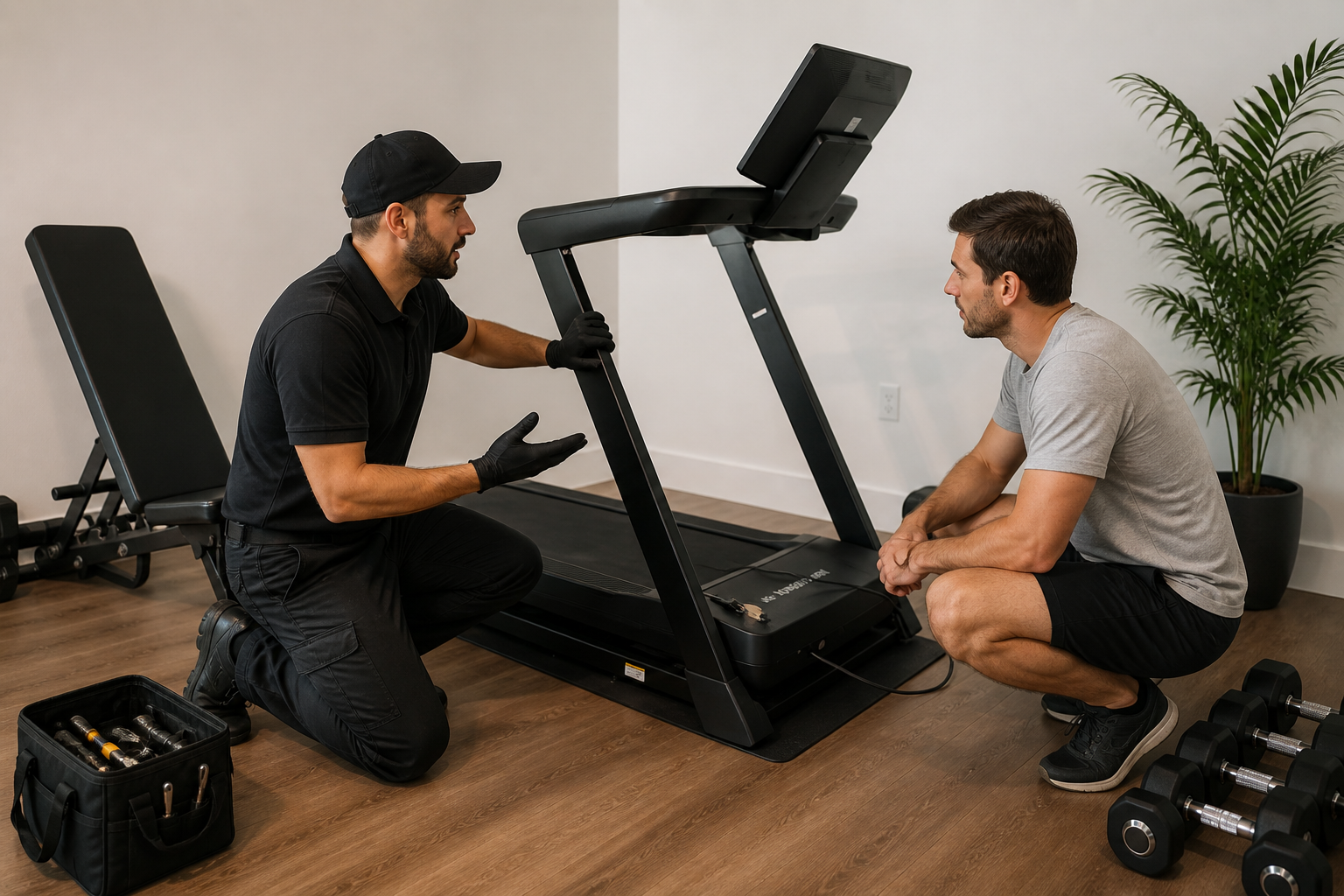

Gym equipment repair in Dallas Fort Worth covers everything from a treadmill walking belt that slips underfoot to an elliptical resistance magnet that stopped responding mid-workout. Whether you have a single treadmill in a spare bedroom or a full home gym setup, the problems that show up are predictable once you have seen enough of them. This guide breaks down what is actually happening inside your machine, what mistakes make it worse, and what to expect when you call a qualified technician in the DFW area.
Common Symptoms
- Treadmill belt slipping or hesitating: The walking belt loses grip under load, especially when you push off at higher speeds. This usually means the belt is worn, the tension roller needs adjustment, or the drive motor is struggling.
- Burning smell during use: A hot plastic or rubber odor points to friction between a worn walking belt and the deck, or an overheating motor control board pushing too much current to compensate for mechanical drag.
- Elliptical resistance not changing: You press the resistance button and nothing happens. The eddy current brake or resistance magnet may have failed, or the console has lost communication with the motor control board.
- Treadmill stops suddenly and throws an error code: Abrupt shutdowns mid-session often trace back to a failing reed switch, a loose magnet on the flywheel, or a motor control board that is cutting power to protect itself.
- Incline not moving or getting stuck: The incline actuator is a motorized screw drive. When it fails, the platform either stays flat, drifts on its own, or grinds and stops partway through a change.
- Loud clunking or grinding noise: Rhythmic noise that matches your stride usually means a worn roller bearing, a loose drive belt, or debris caught between the walking belt and the deck.
- Console powers on but machine will not run: The display lights up, but pressing start does nothing. This points to a failed drive motor, a tripped safety circuit, or a dead motor control board that is receiving signal but not delivering power.
Root Causes: What Is Actually Happening
- Walking belt wear and improper lubrication: The walking belt runs over a phenolic deck thousands of times per session. Without regular silicone lubrication, friction builds up between the two surfaces, which forces the drive motor to work harder, raises operating temperature, and accelerates wear on both the belt and the deck. Most residential users never lubricate the belt at all.
- Motor control board failure: The motor control board regulates voltage to the drive motor. In older machines or machines that run on circuits shared with other high-draw appliances, voltage spikes and heat cycles degrade the capacitors and transistors on the board over time. Once a board starts failing, you will see inconsistent speed, random shutdowns, or a machine that will not start at all.
- Reed switch and magnet misalignment: The reed switch reads a small magnet attached to the flywheel to track speed and trigger safety shutdowns. If the magnet shifts position or the reed switch bracket bends slightly, the console loses its speed signal and the machine stops as a precaution. This is one of the most misdiagnosed problems in the field because the symptom looks identical to a drive motor failure.
- Incline actuator mechanical failure: The incline actuator uses a threaded rod driven by a small motor to raise and lower the front of the treadmill frame. The internal gear set inside the actuator strips out after years of use, especially on machines where the incline is used frequently at higher percentages. A stripped actuator will hum but not move, or move erratically.
- Resistance magnet and eddy current brake degradation on ellipticals: Elliptical resistance systems use a resistance magnet that moves closer to or farther from a spinning flywheel to create drag through eddy currents. The magnet is positioned by a small servo or stepper motor. When the positioning motor fails or the magnet bracket corrodes, resistance levels stop responding accurately or lock at one setting.
- Drive belt stretching and slipping: The drive belt transfers power from the drive motor to the front roller on a treadmill. Over time, the belt stretches and the tension roller can no longer take up the slack. A loose drive belt causes the walking belt to surge and hesitate, which is often mistaken for a motor problem when the actual fix is a new drive belt and tension adjustment.
What NOT to Do
- Do not spray WD-40 on the walking belt: WD-40 is a solvent and water displacer, not a lubricant. Applying it to a treadmill deck breaks down the existing surface coating, causes the walking belt to swell unevenly, and accelerates wear on both components. Use only 100 percent silicone lubricant formulated for treadmills.
- Do not keep running a machine that smells like burning: A burning smell means something is overheating right now. Continuing to use the machine can turn a belt and deck replacement into a motor control board replacement or a full drive motor replacement. Shut it down and leave it off until a technician looks at it.
- Do not swap the motor control board before diagnosing the drive motor: Motor control boards for name-brand treadmills run between 150 and 400 dollars. If the drive motor has failed and is drawing excessive current, a new board will burn out in the same way the original did. Always test motor resistance and current draw before ordering a board.
- Do not overtighten the walking belt: A common DIY fix attempt is cranking the rear roller bolts to stop belt slippage. An overtightened belt puts extreme load on the front and rear roller bearings, the drive motor shaft, and the motor control board. It will stop the slipping temporarily and cause three new problems within weeks.
Professional Gym Equipment Repair in Dallas Fort Worth
2EZ TEK has built a reputation across Dallas Fort Worth on the back of over 500 five-star reviews and a straightforward approach: show up fast, diagnose accurately, and fix it right the first time. Most repairs are scheduled within the same week of your call. We carry common parts for the brands we service most frequently, which cuts down on the back-and-forth that drags out repairs at larger operations. We work on NordicTrack, ProForm, Bowflex, Life Fitness, Precor, Peloton, Sole, Horizon, and most other residential and light commercial brands found in DFW homes and facilities.
One thing that separates 2EZ TEK from the national franchise repair chains operating in this market is that we actually serve residential clients. A large number of competitors in the Dallas Fort Worth area focus exclusively on commercial gyms and apartment complexes. Homeowners with a treadmill in the garage or an elliptical in the spare room get turned away or pushed to the back of the schedule. That is not how we operate. Residential clients make up a significant portion of our business, and we treat a single home treadmill with the same priority as a commercial account.
When you call a national franchise, you are often talking to a call center that dispatches a technician you have never met, with variable parts availability and no local accountability. With 2EZ TEK, you are talking directly to the people doing the work. We know the DFW market, the common failure patterns on machines sold through local retailers, and how to source parts quickly for the brands that are popular in this area. That local knowledge makes a real difference in how fast your machine gets back up and running.
Frequently Asked Questions
How much does gym equipment repair cost in Dallas Fort Worth?
Repair costs vary by machine type and what failed. A walking belt and deck replacement on a residential treadmill typically runs between 200 and 400 dollars including parts and labor. A motor control board replacement can range from 250 to 500 dollars depending on the brand. Incline actuator replacements usually fall in the 200 to 350 dollar range. A diagnostic visit will give you a firm quote before any work begins, so there are no surprises on the final invoice.
Is it worth repairing an older treadmill or should I just buy a new one?
If the machine is a mid-range or higher-end brand and the frame is solid, repair almost always makes more financial sense than replacement. A new treadmill in the same performance category costs 1,000 to 2,500 dollars. Most repairs, even significant ones like a drive motor or motor control board, come in well under that number. The exception is when multiple major components have failed at the same time on a low-end machine, where the repair cost approaches or exceeds the replacement cost of the unit.
How long does a typical repair take once I schedule a visit?
Most repairs are completed during the initial visit if the part is in stock or available locally. For parts that need to be ordered, the typical turnaround is a few days to a week depending on the brand and component. We aim to have every machine back in service within the same week of the first visit whenever possible. You will know the expected timeline before we leave your home after the diagnostic.
Ready to Get It Fixed?
Contact 2EZ TEK today to schedule your same-week gym equipment repair anywhere in Dallas Fort Worth. We will diagnose the problem accurately and get your machine running again without the runaround.