

Every 6 months is the right service interval for most residential treadmills. If you are using your machine more than 5 hours per week, or if it lives in a garage where it collects dust and deals with Texas heat, you should lean toward every 4 to 5 months instead. Skipping routine service is the single most common reason treadmills fail before their time.
The Full Answer
A treadmill has several components that wear down gradually and quietly. The walking belt stretches and dries out over time. The deck surface underneath it gets scored from friction. The drive motor works harder as belt tension increases, drawing more current and generating more heat. None of this is obvious until something breaks. A 6-month service interval catches these problems while they are still cheap to fix, before a worn belt takes out a motor control board or a dry deck warps and cracks.
Lubrication is the most time-sensitive part of maintenance. Most residential treadmills use a silicone-based lubricant applied between the walking belt and the deck. That lubricant breaks down from heat and use, and once it is gone, friction climbs fast. The drive motor compensates by pulling more amperage, which stresses the motor control board. In Dallas Fort Worth, where garages and bonus rooms can hit 90 degrees in summer, lubricant burns off faster than it would in a climate-controlled space. That alone is a reason to service more frequently if your machine is not in an air-conditioned room.
Belt tension and alignment are the other big items. A walking belt that is too loose will slip under load. One that is too tight puts strain on the drive motor, the front roller, and the rear tension roller. Alignment issues cause the belt to drift to one side, wearing the edges unevenly and eventually damaging the deck. These adjustments take a few minutes with the right tools but require knowing the correct tension spec for your specific model, which varies between manufacturers and frame sizes.
Related Problems to Watch For
- Burning smell during use: This usually means the walking belt is running dry against the deck, or the drive motor is overheating from excess friction. Both need immediate attention.
- Belt slipping under load: If the belt hesitates or slips when you step on it, the tension roller may need adjustment or the drive belt connecting the motor to the front roller may be worn.
- Speed inconsistency: Fluctuating speed at a set pace often points to a failing motor control board or a worn reed switch that is sending bad speed data to the controller.
- Loud grinding or squeaking: Roller bearings wear out over time. A grinding noise from the front or rear of the machine usually means a bearing is failing and needs replacement before it seizes.
- Incline not responding: On machines with power incline, the incline actuator can wear out or lose calibration. This is separate from belt maintenance but often caught during a routine service visit.
- Console errors or shutdowns: Intermittent error codes and unexpected shutdowns are often electrical, but they can also be triggered by a motor pulling too much current due to a dry belt or misaligned deck.
What This Repair Actually Involves
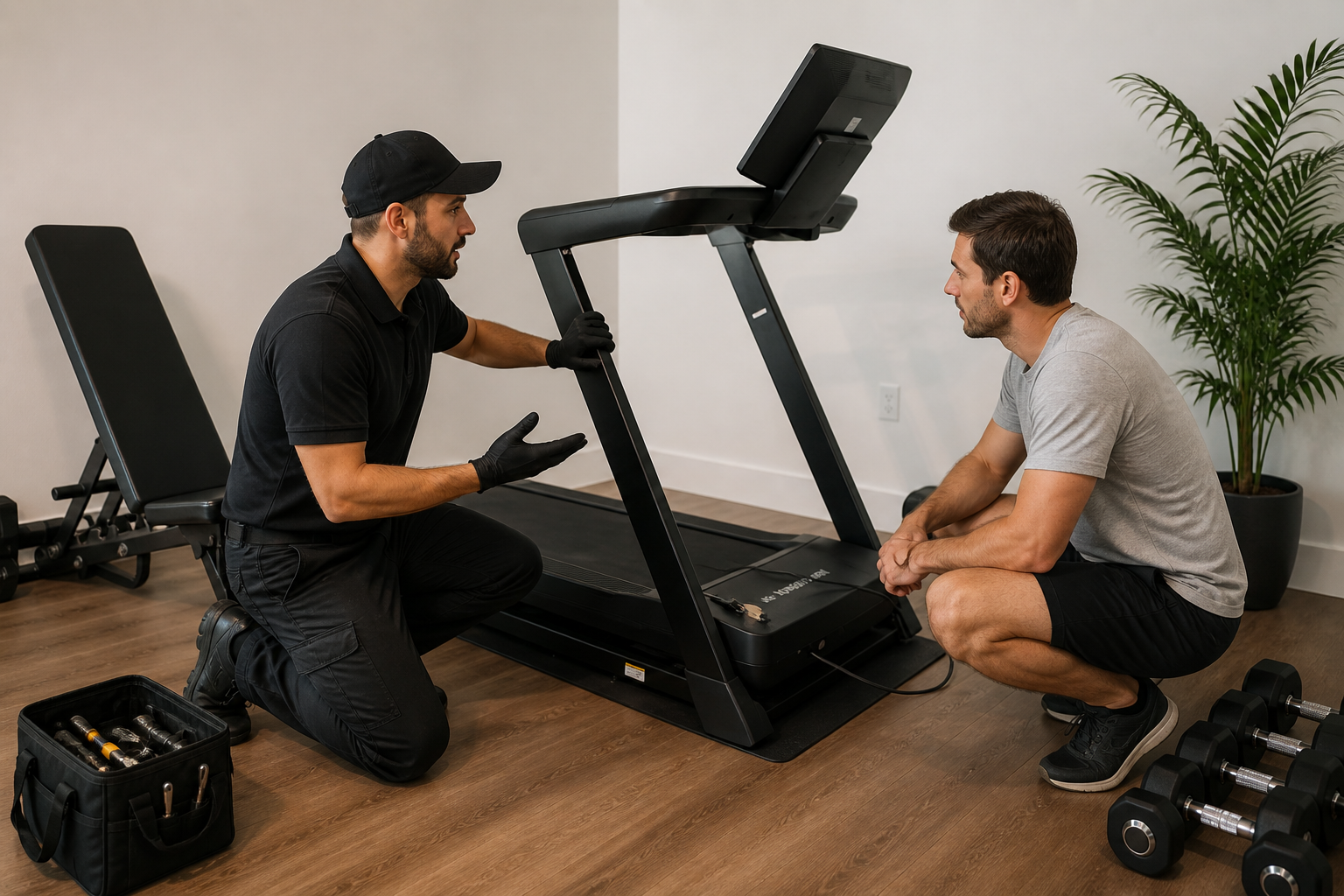
- Visual and operational inspection: The technician runs the treadmill through its speed and incline range, listening for abnormal sounds and watching belt tracking. This surfaces issues that do not show up when the machine is sitting still.
- Belt and deck assessment: The walking belt is lifted to check the underside for glazing, cracking, or fraying. The deck surface is inspected for scoring or uneven wear. If the deck is worn through its wax coating, it needs to be flipped or replaced, not just lubricated.
- Lubrication: Silicone lubricant is applied evenly across the deck surface under the walking belt. The belt is then run at low speed to distribute it. The type and amount of lubricant matters. Too much is as problematic as too little.
- Belt tension and alignment adjustment: The rear roller bolts are adjusted to set proper tension, then fine-tuned for alignment so the belt tracks centered. This is done while the machine is running and requires patience to get right.
- Electrical and safety check: The power cord, safety key, motor control board connections, and drive motor are checked for signs of wear, corrosion, or heat damage. The emergency stop function is tested to confirm it cuts power immediately.
When to DIY vs. Call a Technician
There are a few things homeowners can reasonably do themselves. Wiping down the belt and frame after each use is simple and effective. Applying lubricant every 3 months on a machine you use lightly is manageable if you use the correct silicone product and follow your owner's manual. Some manufacturers print a lubrication interval on a sticker near the motor cover. If yours does, follow it. What you should not attempt without experience is belt tension adjustment. Getting it wrong in either direction causes damage, and the correct tension varies by model in ways that are not always obvious from the manual.
Anything electrical is a firm call-a-technician situation. Motor control boards carry capacitors that hold charge even after the machine is unplugged. Drive motors can be damaged by incorrect testing. If your machine is throwing error codes, shutting down unexpectedly, or showing signs of electrical burning, do not open the motor cover and start probing. The repair cost for a board you accidentally damage is almost always higher than the cost of having a technician diagnose it correctly the first time.
More Questions Customers Ask
What happens if I skip lubrication for too long?
The walking belt and deck create friction without lubrication, which forces the drive motor to work harder. Over time, this excess load can overheat the motor control board and cause it to fail. A new motor control board typically costs more than several years of routine maintenance visits. In some cases, the deck itself gets scored badly enough that it needs to be replaced along with the belt, turning a simple lubrication job into a much larger repair.
How do I know if my treadmill needs service before the 6-month mark?
A few signs tell you the machine needs attention sooner. If the belt feels sluggish when you step on it, if you hear a squeaking or grinding noise from the rollers, if the machine smells like burning plastic or rubber during use, or if the belt is visibly drifting to one side, do not wait for the scheduled interval. These are signs that something is already wearing faster than expected. Heavy use, high heat, and dusty environments all accelerate wear and can push the service interval closer to every 3 to 4 months for some households.
Get This Fixed in Dallas Fort Worth
2EZ TEK serves residential customers across Dallas Fort Worth, including homeowners who have been turned away by companies that only take commercial accounts. If your treadmill is in your guest room, garage, or home gym, we work on it. Contact us to schedule a preventative maintenance visit and we will get you on the calendar within the same week.