
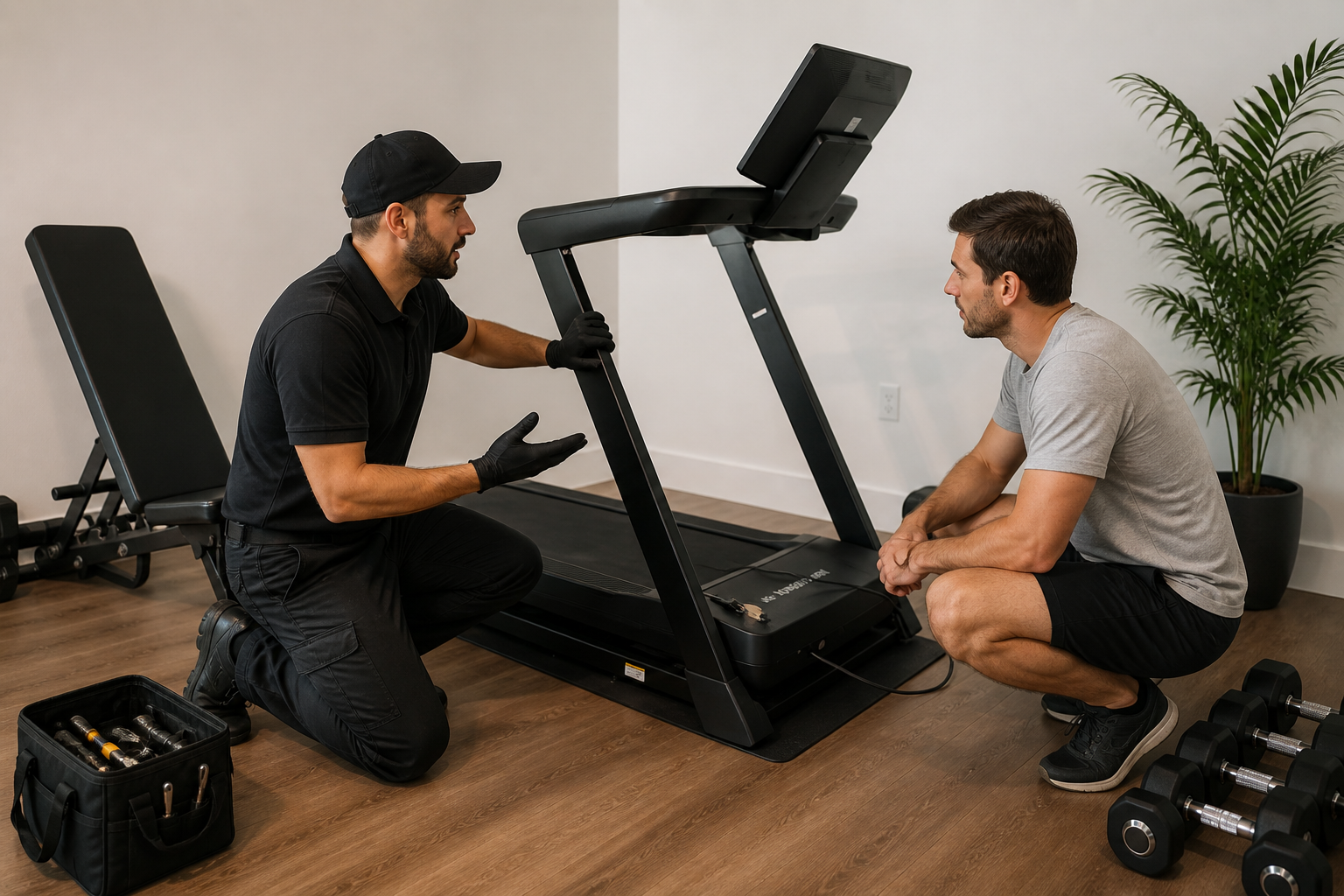

Treadmill repair in Dallas is one of the most common service calls we handle at 2EZ TEK, and most problems fall into a short list of root causes. Whether your belt is slipping, the machine won't power on, or the incline stopped responding mid-workout, this guide walks you through what is actually happening inside the machine and what you should do about it. We have serviced hundreds of treadmills across Dallas Fort Worth, from basic entry-level units to high-end commercial-grade machines sitting in home gyms, and the failure patterns repeat themselves constantly.
Common Symptoms
- Belt slipping or hesitating under load: You step on the treadmill and the walking belt stutters, slows down, or jerks when you put your full weight on it. This is one of the most reported issues and almost always has a mechanical or electrical cause that gets worse if ignored.
- Treadmill won't turn on: You press the power button and nothing happens. No display, no motor hum, no response at all. This can range from a blown fuse to a failed motor control board.
- Burning smell during use: A sharp, acrid smell coming from under the hood usually means the walking belt is generating excessive friction against the deck, or the drive motor is overheating under strain.
- Speed fluctuates on its own: The belt speeds up and slows down without you touching the controls. This often points to a failing motor control board or a worn drive motor that can no longer hold a consistent RPM.
- Incline stops working or gets stuck: The incline actuator moves the front of the treadmill up and down. When it fails, the machine either stays flat, climbs to maximum grade and stays there, or throws an error code.
- Loud squeaking or grinding noise: A rhythmic squeak usually comes from the tension roller or the rear roller bearing. A grinding sound often means the drive motor bearings are wearing out.
- Error codes on the display: Modern treadmills throw codes like E1, E2, or LS when sensors or components fail. These codes are diagnostic starting points, not final answers.
Root Causes: What Is Actually Happening
- Worn or glazed walking belt and deck: The walking belt rides on a phenolic deck board. Over time, the underside of the belt and the top surface of the deck wear against each other and lose lubrication. The resulting friction forces the drive motor to work harder than it was designed to, which causes overheating, belt slippage, and eventually motor failure. Most manufacturers recommend lubricating the deck every three to six months depending on use.
- Failed motor control board: The motor control board regulates the voltage and current sent to the drive motor. Capacitors on the board degrade over time, especially in homes with inconsistent power supply or where the machine is plugged into an unprotected outlet. A failed board can cause erratic speed, complete power loss, or a machine that trips the circuit breaker every time you start it.
- Drive motor failure: The drive motor is the core of the machine. Brushed DC motors, which most residential treadmills use, have carbon brushes that wear down after years of use. Once the brushes are gone, the motor loses torque, overheats, and eventually stops turning the belt entirely. You can sometimes hear this coming as a high-pitched whine before full failure.
- Reed switch or speed sensor malfunction: The reed switch reads a magnet on the front roller to calculate belt speed and report it to the console. When the reed switch drifts out of alignment or fails outright, the console loses speed data and the machine either throws an error or behaves erratically. This is a small, inexpensive part that causes a lot of confusion because the symptom looks like a major electrical failure.
- Incline actuator or incline motor failure: The incline actuator is a linear motor that physically lifts the front of the treadmill frame. The internal gears and motor windings wear out, especially on machines that are used at high incline settings regularly. A failed actuator can leave the machine stuck at an angle or completely unresponsive to incline commands.
- Loose or stretched walking belt: A belt that has stretched beyond its adjustment range will slip under load even if the deck and motor are in good condition. The tension roller at the rear of the machine can only compensate so much. At a certain point, the belt needs to be replaced outright.
What NOT to Do
- Do not keep running a slipping belt: Every minute you run on a slipping belt, you are forcing the drive motor to compensate for the extra friction. What starts as a belt and deck problem turns into a drive motor replacement, which costs significantly more. Stop using the machine and get it looked at.
- Do not spray WD-40 on the belt or deck: WD-40 is a solvent, not a lubricant, and it will destroy the walking belt material and contaminate the deck surface. Treadmills require 100 percent silicone lubricant applied specifically under the belt to the deck surface. Using the wrong product turns a simple lubrication job into a belt and deck replacement.
- Do not reset error codes and keep running: Error codes are the machine telling you something is wrong. Clearing the code and continuing to use the treadmill without diagnosing the underlying cause accelerates component damage. An E2 code that gets ignored for a few weeks can go from a sensor fix to a full motor control board replacement.
- Do not attempt to replace the motor control board without diagnosing the actual cause: Motor control boards are expensive, sometimes over two hundred dollars for a single part. If the board failed because of a worn belt creating excessive current draw, replacing the board without fixing the belt will burn out the new board within weeks. Diagnosis has to come before parts replacement.
Professional Treadmill Repair in Dallas Fort Worth
2EZ TEK has been servicing treadmills across Dallas Fort Worth for years, and one thing that sets us apart from the national franchise repair companies is that we actually show up for residential customers. A lot of competitors in DFW focus exclusively on commercial gyms and corporate fitness centers. Homeowners with a treadmill in the garage or spare bedroom often get turned away or pushed to the back of the schedule. We built our business around residential service, and the majority of our 500-plus five-star reviews come from homeowners who needed someone to actually show up and fix their machine at home.
We service all major treadmill brands including NordicTrack, ProForm, Bowflex, Life Fitness, Precor, Sole, Horizon, and Peloton Tread. Our technicians carry common parts on the truck, including walking belts, motor control boards, reed switches, and drive motors for the most frequently serviced models. That means we can often complete the repair in a single visit rather than ordering parts and making you wait another week. We offer same-week scheduling across Dallas, Plano, Frisco, McKinney, Arlington, and surrounding areas.
When you call a national franchise, you are often talking to a call center that dispatches a generalist technician with limited parts inventory. With 2EZ TEK, you get a technician who has seen your specific failure mode dozens of times and comes prepared. We give you a straight diagnosis, a clear price, and we do not upsell you on parts you do not need.
Frequently Asked Questions
How much does treadmill repair cost in Dallas?
It depends on what is wrong. A belt lubrication service runs significantly less than a motor control board replacement. Most repairs fall somewhere between a basic service call and a major component swap. We diagnose the machine first and give you a firm quote before any work begins. There are no surprise charges after the fact.
Is it worth repairing an older treadmill or should I just buy a new one?
That depends on the age of the machine, the brand, and what failed. A ten-year-old entry-level treadmill with a dead motor control board and a worn belt is probably not worth a full repair. A five-year-old NordicTrack or Life Fitness with a single failed component almost always makes sense to fix. We will give you an honest assessment. If the repair cost is close to replacement cost, we will tell you that directly rather than push you into a repair that does not make financial sense.
How long does a treadmill repair take?
Most repairs are completed in a single visit once we have the parts. If we need to order a specific motor control board or drive motor for a less common model, turnaround is typically a few days. We will give you a realistic timeline when we diagnose the machine, not a vague estimate that keeps getting pushed back.
Ready to Get It Fixed?
Contact 2EZ TEK today to schedule your treadmill repair in Dallas Fort Worth. We offer same-week service for residential customers across the DFW area and we will give you a straight answer on what it costs before we start.