
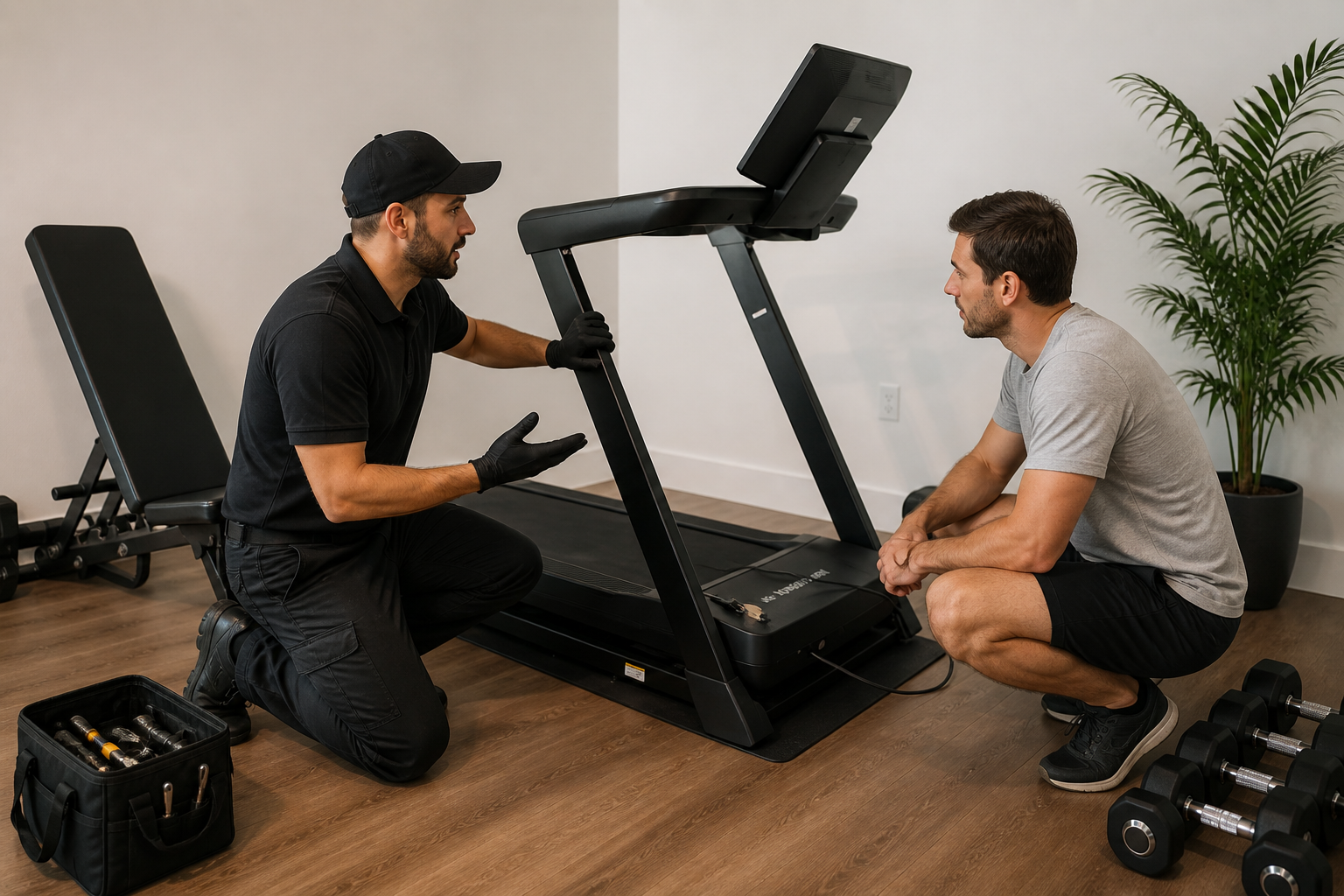

Treadmill repair in Dallas is one of the most common service calls we handle at 2EZ TEK, and the problems we see follow predictable patterns. Whether your belt is slipping, your motor is surging, or the machine just stopped turning on, the fix almost always comes down to a handful of components: the walking belt, the drive motor, the motor control board, or the deck surface underneath. This guide will walk you through what is actually happening inside your machine so you can make a smart decision before spending money on parts or a technician.
Common Symptoms
- Belt slipping or hesitating under load: You step on the treadmill and the belt jerks, slows down, or skips. This usually gets worse when you increase speed or incline.
- Burning smell during or after use: A sharp, acrid smell coming from under the motor hood is a sign that friction between the walking belt and deck has gotten out of hand, or that the drive motor is overheating.
- Treadmill stops mid-workout: The machine shuts off without warning, sometimes throwing an error code, sometimes going completely dark. This points toward the motor control board or a thermal cutoff triggered by heat buildup.
- Loud grinding or squealing noise: A rhythmic grinding sound that matches the belt speed usually means the rear roller bearings are worn. A high-pitched squeal often points to the front drive roller or the tension roller.
- Incline not responding or stuck at one angle: The incline actuator is a motorized screw mechanism. When it fails, the deck either stays flat, climbs to max incline and stops, or makes a clicking noise without moving.
- Console not powering on: If the display is completely dead, the issue is often the power switch, the reed switch on the safety key circuit, or a failed motor control board that is no longer sending voltage upstream.
- Speed readout is inaccurate or erratic: The treadmill runs but the speed display jumps around or reads zero. The magnetic speed sensor, also called the reed switch, is almost always the culprit here.
Root Causes: What Is Actually Happening
- Walking belt and deck wear: The walking belt rides on a phenolic deck board thousands of times per session. Over time, the wax coating on the deck burns off and the friction between belt and deck increases dramatically. This forces the drive motor to work harder than it was designed to, which overheats the motor control board and eventually causes component failure downstream.
- Drive motor failure: The drive motor is a DC motor typically rated between 2.0 and 4.0 continuous horsepower on residential machines. Brushes inside the motor wear down over years of use, carbon deposits build up on the commutator, and the motor loses torque. You will notice this as sluggishness at low speeds before the motor stops working entirely.
- Motor control board burnout: The motor control board regulates voltage to the drive motor and receives speed signals from the console. When the walking belt and deck generate excess friction, the board compensates by drawing more current. That sustained overcurrent burns out capacitors and transistors on the board. A board that failed this way will often fail again quickly if the underlying belt and deck issue is not also addressed.
- Rear roller bearing failure: The rear tension roller keeps the walking belt taut and centered. The bearings inside it are sealed but not immune to sweat, dust, and time. Once the bearing races pit or corrode, you get that grinding noise and uneven belt tracking that pulls to one side.
- Incline actuator or lift motor failure: The incline actuator is a sealed linear actuator driven by a small DC motor. The internal gears strip under repeated use or when the actuator is asked to move a deck that has binding hardware. When the gears strip, the actuator spins without moving the deck, and you hear clicking or humming with no incline change.
- Reed switch and sensor issues: The reed switch is a small magnetic sensor mounted near the front roller. It reads a magnet embedded in the roller to calculate belt speed. Sweat and debris can corrode the sensor leads or knock the magnet out of alignment, causing erratic speed readings or a complete loss of signal that prevents the machine from starting.
What NOT to Do
- Do not lubricate the top of the walking belt: Silicone lubricant goes under the belt, between the belt and the deck. Spraying it on top creates a slippery surface that is a safety hazard and does nothing to reduce the friction causing your problem.
- Do not keep running a treadmill that smells like burning: That smell is your motor control board or drive motor being destroyed in real time. Every minute you run it in that condition adds cost to the repair. Shut it down and leave it off until a technician looks at it.
- Do not replace the motor control board without checking the belt and deck first: This is the most expensive mistake homeowners make. A new board installed on a worn belt and dry deck will fail within weeks for the same reason the original board failed. The board is often a symptom, not the root cause.
- Do not assume a dead console means a dead treadmill: Homeowners frequently write off a machine because the display went dark, then buy a new treadmill. In many cases the issue is a tripped circuit breaker on the machine itself, a failed reed switch, or a power supply problem that costs a fraction of a new unit to fix.
Professional Treadmill Repair in Dallas Fort Worth
2EZ TEK has handled treadmill repairs across Dallas Fort Worth for years, and one thing separates us from the national franchise repair chains: we work on residential equipment. Most of our competitors focus exclusively on commercial gyms and fitness facilities. If you call them about the treadmill in your spare bedroom or garage, you may get turned away or placed on a waiting list that stretches for weeks. We built our business around homeowners, and residential treadmill repair makes up a large part of what we do every day.
We service all major brands including NordicTrack, ProForm, Sole, Bowflex, LifeFitness, Precor, Horizon, and Peloton Tread. With over 500 five-star reviews from customers across the Metroplex, our reputation is built on showing up on time, diagnosing the actual problem, and fixing it correctly the first visit. We offer same-week service appointments throughout Dallas, Fort Worth, Plano, Frisco, Arlington, and surrounding areas. We carry common parts on our service vehicles so most repairs are completed in a single trip.
Our diagnostic process covers the full machine, not just the part that failed. When we replace a motor control board, we also inspect the walking belt, lubricate the deck, check roller bearings, and test the incline actuator. That approach is why our repairs hold up and why customers call us back when they buy a second machine instead of searching for someone new.
Frequently Asked Questions
How much does treadmill repair cost in Dallas?
Repair costs vary depending on what failed. A belt lubrication and tune-up runs significantly less than a motor control board replacement. Most residential treadmill repairs in Dallas fall between $150 and $450 parts and labor. A drive motor replacement on a higher-end machine can run more. We give you a firm quote after diagnosis so there are no surprises on the final invoice.
Is it worth repairing an older treadmill or should I just buy a new one?
If the frame is solid and the machine is a mid-range or better brand, repair almost always makes financial sense. A new treadmill in the same performance category as your current machine costs $1,200 to $2,500 or more. Most repairs cost a fraction of that. The exception is a very cheap machine where parts are no longer available or where the repair cost approaches the replacement cost. We will tell you honestly if your machine falls into that category.
How long does a treadmill repair appointment take?
Most repairs are completed in one to two hours on-site. If a part needs to be ordered, we schedule a follow-up visit once it arrives, typically within a few days. We do not leave jobs open-ended. You will know the timeline before we leave your home after the initial diagnostic visit.
Ready to Get It Fixed?
Contact 2EZ TEK today to schedule your treadmill repair in Dallas Fort Worth and get your machine back in working order with a same-week appointment from a technician who has seen this problem before.