
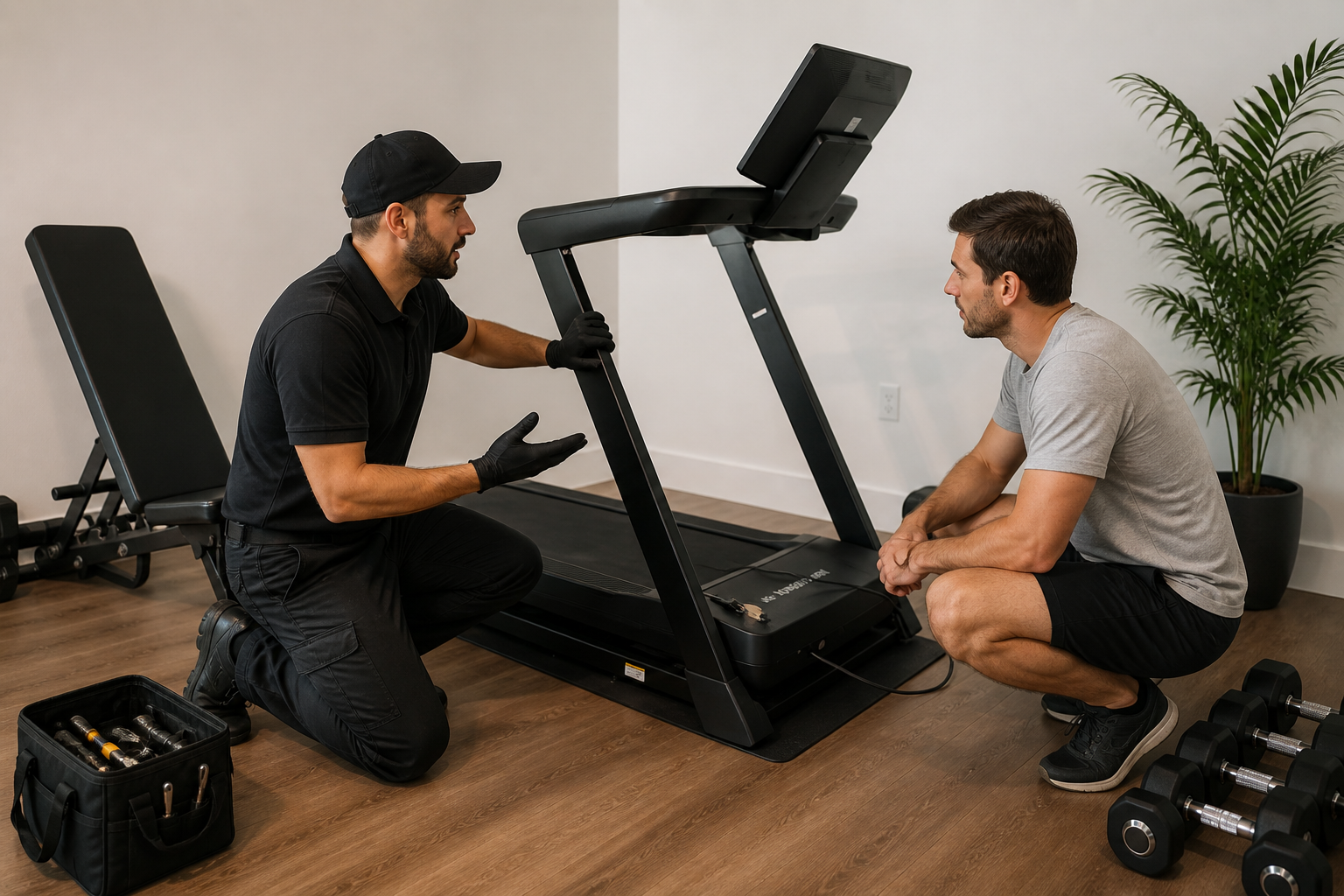

This guide is built from real service calls, not manufacturer documentation or generic repair forums. Over the past service period, our technicians completed 83 treadmill repair calls across Dallas Fort Worth, covering brands including the Sole ST90, Sole F63, Sole F85, Nautilus T618, and Peloton Tread. The problems showing up on customer intake forms right now include rhythmic clicking from the rear roller area, walking belts with edge splits from long storage, consoles that went dark after a move, and units that simply will not start. If any of that sounds familiar, keep reading.
The Most Common Problems We Are Seeing
- Rear Roller Clicking (Sole ST90): This is one of the most searched issues we are getting right now, with customers specifically typing things like "Sole ST90 clicking sound in back" to find us. The clicking is almost always tied to a worn rear tension roller bearing or a walking belt that has shifted slightly off track. Left alone, a failing rear roller bearing will eventually score the belt and damage the roller surface itself, turning a straightforward bearing swap into a full roller and belt replacement.
- Walking Belt Edge Splits: We are seeing belts come in with one to two inch splits running along the side edge, often on machines that sat unused for eight months or longer. When a treadmill goes dormant, the belt loses lubrication, the underside dries out, and the edges become brittle where they wrap around the front and rear rollers. These belts cannot be patched and need full replacement, along with a deck inspection to confirm the running surface has not been scored.
- Console Not Powering On After a Move (Nautilus T618): We received intake forms specifically describing this on the T618. The console receives power through a wiring harness that runs from the motor control board up through the upright frame. During a move, these connectors get pulled, pinched, or partially seated. The power switch may light up because it draws from a separate circuit, but the console stays dark because the data or power connection to the display board is interrupted.
- Treadmill Will Not Start or Run: This is one of the broadest complaints we see and it covers several root causes. The most common are a failed motor control board, a tripped or degraded circuit breaker on the lower board, or a worn drive motor that draws too much current and triggers a protective shutdown. On older Sole and Nautilus units, the motor control board is often the first component to fail when the machine has been running in a hot garage environment.
- Post-Move Reassembly and Calibration Issues: A significant number of our calls this period came from customers who had just moved and needed their treadmill reassembled and verified. This is not just a bolt-tightening job. The walking belt tension has to be set correctly at the rear roller adjustment bolts, the belt tracking has to be centered, and the incline actuator linkage has to be confirmed seated and functional before the machine is safe to run.
- Delayed Repairs from Parts Already Ordered: We are also seeing cases where a part was diagnosed and ordered over a month ago but the repair was never completed. In these situations, the machine has been sitting, sometimes with a disassembled frame or a removed motor cover. We can step in, verify the ordered part is correct, and complete the installation even when we were not the ones who started the job.
Warning Signs You Should Not Ignore
- Rhythmic clicking or thumping from the rear of the machine: This points to the rear roller bearing or a belt that is catching on the roller edge. The interval of the sound will match the belt rotation speed, and it will get worse as the belt warms up.
- Belt that feels slow or hesitates under your foot: This usually means the drive motor or motor control board is struggling to maintain speed under load. Running on it further risks burning out the motor entirely.
- Console display flickering or showing error codes at startup: Error codes on Sole and Nautilus units often point to a speed sensor or reed switch signal problem. Ignoring these codes and continuing to run the machine can corrupt the motor control board settings.
- Burning smell during or after use: A burning smell almost always means the walking belt is running dry against the deck, or the drive motor is overheating. Stop using the machine immediately and do not restart it until the belt is lubricated or the motor is inspected.
- Visible cracking or splitting along the belt edge: A belt with edge damage is a safety issue. The split can propagate across the belt width during use, causing the belt to catch or bunch under the running surface.
Why Dallas Fort Worth Conditions Matter
Dallas Fort Worth summers push garage temperatures well above 100 degrees Fahrenheit for months at a time. Treadmills stored or used in unconditioned garages take a beating that machines in climate-controlled spaces simply do not experience. The motor control board is particularly vulnerable because it relies on ambient air cooling. When the surrounding air is already at 105 degrees, the board runs hot even at low speeds, and the capacitors on the board degrade faster than the manufacturer's rated lifespan. Walking belt lubricant also evaporates much faster in high heat, which accelerates deck wear and increases the friction load on the drive motor.
We also see a distinct wear pattern on treadmills in apartment complexes and residential gym setups where one or two people use the same machine daily at the same speed and incline. The walking belt develops a wear channel directly under the most-traveled foot strike zone, and the deck surface becomes glazed in that strip. This kind of wear is invisible from the outside but shows up immediately when you flip the belt over during a service call. Commercial volume gyms have their own challenges, but the majority of our calls this period were from residential homeowners, and the garage heat and single-user wear patterns are the dominant factors we are diagnosing against.
DIY vs. Calling a Technician
There are a few things homeowners can safely handle. Applying treadmill belt lubricant through the side access slot is straightforward if you follow the manufacturer's specification for silicone lubricant and do not over-apply. Checking that the power cord is fully seated and the reset button on the surge protector or outlet has not tripped is also a reasonable first step before calling anyone. Tightening loose console bolts after a move is fine as long as you are not forcing anything. Beyond that, the risk of making the problem worse goes up quickly. Adjusting rear roller tension bolts without a reference point can throw the belt off center and damage the belt edge within minutes of running. Opening the motor cover and probing the motor control board without knowing how to discharge the capacitors is a genuine electrical hazard.
One thing we want to be direct about: most treadmill repair companies in Dallas Fort Worth only take commercial gym accounts. If you are a homeowner with a treadmill in your living room, garage, or spare bedroom, you have probably already discovered how hard it is to get a technician to come out. At 2EZ TEK, residential service is a core part of what we do. You do not need to be a gym or a business to get professional repair service. We work with individual homeowners across the DFW area every week, and the intake forms we receive reflect that. If you have been turned away by other companies, that is exactly the situation we are set up to help with.
Frequently Asked Questions
My treadmill sat unused for almost a year. Is it safe to just start using it again?
Probably not without an inspection first. After eight to twelve months of sitting, the walking belt lubricant has dried out significantly, and the belt itself may have developed edge cracking that is not visible until the machine is running under load. We recommend having the belt inspected, the underside lubricated or the belt replaced if cracked, and the drive motor checked before you put regular use back on the machine. This is especially true if the treadmill was stored in a garage through a Texas summer.
The console on my Nautilus T618 went dark after we moved. Does that mean the console is broken?
Not necessarily. The most common cause after a move is a disconnected or partially seated wiring harness connector between the motor control board and the display board. The power switch can still illuminate because it draws from a different point in the circuit. A technician can trace the harness, reseat the connectors, and confirm whether the display board itself has been damaged. In many cases this is a connection issue, not a failed component.
How long does a treadmill belt replacement actually take?
On most residential treadmills including Sole and Nautilus models, a walking belt replacement takes between one and two hours on-site. That includes removing the motor cover, loosening the rear roller adjustment bolts, sliding the old belt off, inspecting the deck surface for scoring, installing the new belt, setting tension, centering the tracking, and applying fresh lubricant. If the deck is damaged and needs replacement at the same time, add another thirty to sixty minutes depending on the model.
Book Treadmill Repair in Dallas Fort Worth
If your treadmill is clicking, not starting, showing a blank console, or has been sitting with a split belt, 2EZ TEK can get a technician out to you this week. We serve residential homeowners across Dallas Fort Worth, not just commercial facilities, so call us or book online and we will get your machine back on the floor.