

The circuit breaker on your treadmill or exercise machine is a built-in safety device that cuts power automatically when it detects too much electrical current or a short circuit. It protects both your machine's internal components and your home's wiring from damage. If yours keeps tripping, that is not a nuisance, it is a warning sign that something inside the machine needs attention.
The Full Answer
Most residential treadmills, ellipticals, and bikes have a small resettable circuit breaker mounted somewhere on the frame, usually near the power cord entry point or on the rear roller housing. It works the same way a breaker in your home's electrical panel does, just scaled down for the machine's voltage and amperage range. When current flowing through the machine exceeds the breaker's rated threshold, typically somewhere between 10 and 20 amps depending on the model, the breaker trips and interrupts the circuit. You press the reset button, and if the underlying problem is gone, the machine runs normally again.
The breaker is protecting several expensive components at once. The drive motor is the biggest draw on a treadmill, pulling significant current every time the belt moves, especially under load. The motor control board, which regulates speed and power delivery to the drive motor, is also vulnerable to current spikes. On machines with incline, the incline actuator motor adds another electrical load. If any of these components develop a fault, whether it is a shorted winding in the drive motor, a failing capacitor on the motor control board, or a binding mechanical issue that forces the motor to work harder, the circuit breaker is what stands between a tripped reset button and a burned-out board or motor.
A breaker that trips once after years of use is usually not a big deal. A breaker that trips repeatedly, especially under the same conditions like after a few minutes of use or at a specific incline level, is telling you there is a consistent electrical or mechanical problem. Resetting it and hoping for the best is not a repair strategy. Each time the machine runs in a fault condition before the breaker trips, it is stressing components that are already struggling.
Related Problems to Watch For
- Walking Belt Friction: A worn or improperly lubricated walking belt creates extra drag on the drive motor, which increases current draw and can trip the breaker during use. If the belt feels stiff or you notice the motor straining, belt condition is the first thing to check.
- Drive Motor Failure: A drive motor with worn brushes or a shorted winding will pull more current than normal, often enough to trip the breaker within minutes of starting. The motor may still spin but it will run hot and inefficiently.
- Motor Control Board Faults: A failing motor control board can send irregular power signals to the drive motor, causing current spikes that trip the breaker. You may also notice speed fluctuations or a burning smell before the breaker trips.
- Incline Actuator Issues: On treadmills with power incline, a binding or failing incline actuator motor draws extra current every time the incline changes. If the breaker only trips when you adjust incline, this is the likely culprit.
- Loose or Damaged Wiring: Frayed wires, loose terminal connections, or damaged insulation inside the machine can cause intermittent shorts that trip the breaker unpredictably. This is also a fire risk if left unaddressed.
- Extension Cord Use: Plugging a treadmill into an undersized extension cord is one of the most common causes of nuisance tripping in residential settings. Most treadmills require a dedicated 15 or 20 amp outlet with a short, heavy-gauge cord or no extension cord at all.
What This Repair Actually Involves
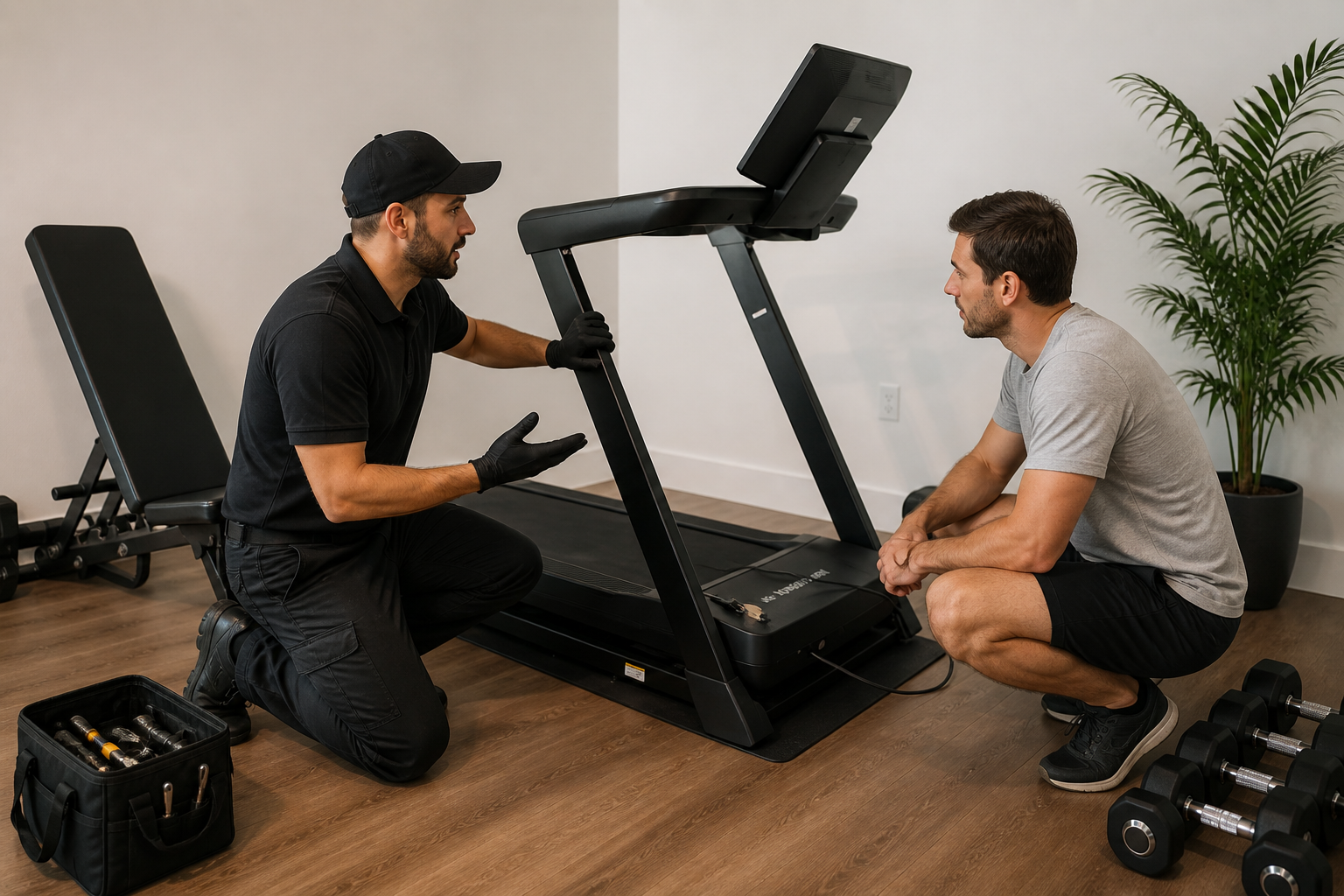
- Confirm the breaker is the source: A technician will first verify that the machine's onboard circuit breaker is tripping and not the home's wall outlet breaker. These are two separate protection points, and the location of the trip tells you a lot about where the fault is.
- Measure current draw at startup and under load: Using a clamp meter, a technician measures the actual amperage the drive motor pulls at startup, at idle, and under simulated walking load. A healthy treadmill motor has a predictable current signature. A motor pulling significantly above spec points to a mechanical binding issue or internal motor fault.
- Inspect the walking belt and deck: Belt tension, lubrication, and wear are checked because a dry or overtightened belt is one of the most common reasons a motor works harder than it should. If the belt is the problem, lubrication or belt replacement resolves the excess current draw.
- Test the motor control board: The board is inspected for burned components, swollen capacitors, and heat damage. A board that is failing internally can cause erratic current spikes even when the motor itself is fine. If the board is the source, it gets replaced rather than patched.
- Check wiring harnesses and connections: Every connector and terminal inside the machine is inspected for corrosion, heat damage, or loose pins. A single bad connection can cause enough resistance to generate heat and trip the breaker under load.
When to DIY vs. Call a Technician
There are a few things a homeowner can safely check before calling anyone. Make sure the machine is plugged directly into a wall outlet, not an extension cord or a power strip. Check that the outlet is on a circuit that is not shared with other high-draw appliances. If the machine has not been lubricated in a year or more, applying treadmill belt lubricant under the walking belt is a low-risk maintenance step that sometimes resolves minor current draw issues on its own. Resetting the circuit breaker once to see if the problem recurs is also reasonable.
Beyond that, working inside a treadmill or elliptical involves live electrical components, capacitors that hold charge even after unplugging, and wiring that is easy to damage if you are not familiar with the layout. If the breaker trips repeatedly, if you smell burning, or if you see any discoloration around the power input or motor area, stop using the machine and call a technician. Continuing to reset and run a machine with an active electrical fault can turn a straightforward repair into a drive motor replacement or a motor control board replacement, both of which cost significantly more than a diagnostic visit.
More Questions Customers Ask
Can I replace the circuit breaker on my treadmill myself?
The breaker itself is usually an inexpensive part and is physically simple to swap out. The problem is that replacing a tripped breaker without finding out why it tripped leaves you with the same fault and a new breaker that will trip again, or worse, one that does not trip when it should. A breaker replacement only makes sense after the underlying cause has been identified and corrected. If the old breaker was tripping because of a legitimate fault, the new one will too.
Why does my treadmill trip the breaker after running for a few minutes but not right away?
This is a classic thermal trip pattern. The drive motor or motor control board starts out within normal operating range but generates heat as it runs. If there is a marginal fault, like a partially shorted motor winding, a failing capacitor on the control board, or a belt that is slightly too tight, the component heats up under load until the current draw crosses the breaker's threshold and it trips. The delay between startup and the trip is actually useful diagnostic information. It tells a technician the fault is load-related or heat-related rather than a hard short, which narrows down the likely components significantly.
Get This Fixed in Dallas Fort Worth
If your treadmill or exercise machine keeps tripping its circuit breaker, 2EZ TEK serves residential customers across Dallas Fort Worth with same-week repair appointments. A lot of homeowners in the area have been turned away by repair companies that only want commercial gym accounts, and that is exactly why 2EZ TEK built its business around home fitness equipment. Call or book online and a technician will diagnose the problem and give you a straight answer on what it will take to fix it.