
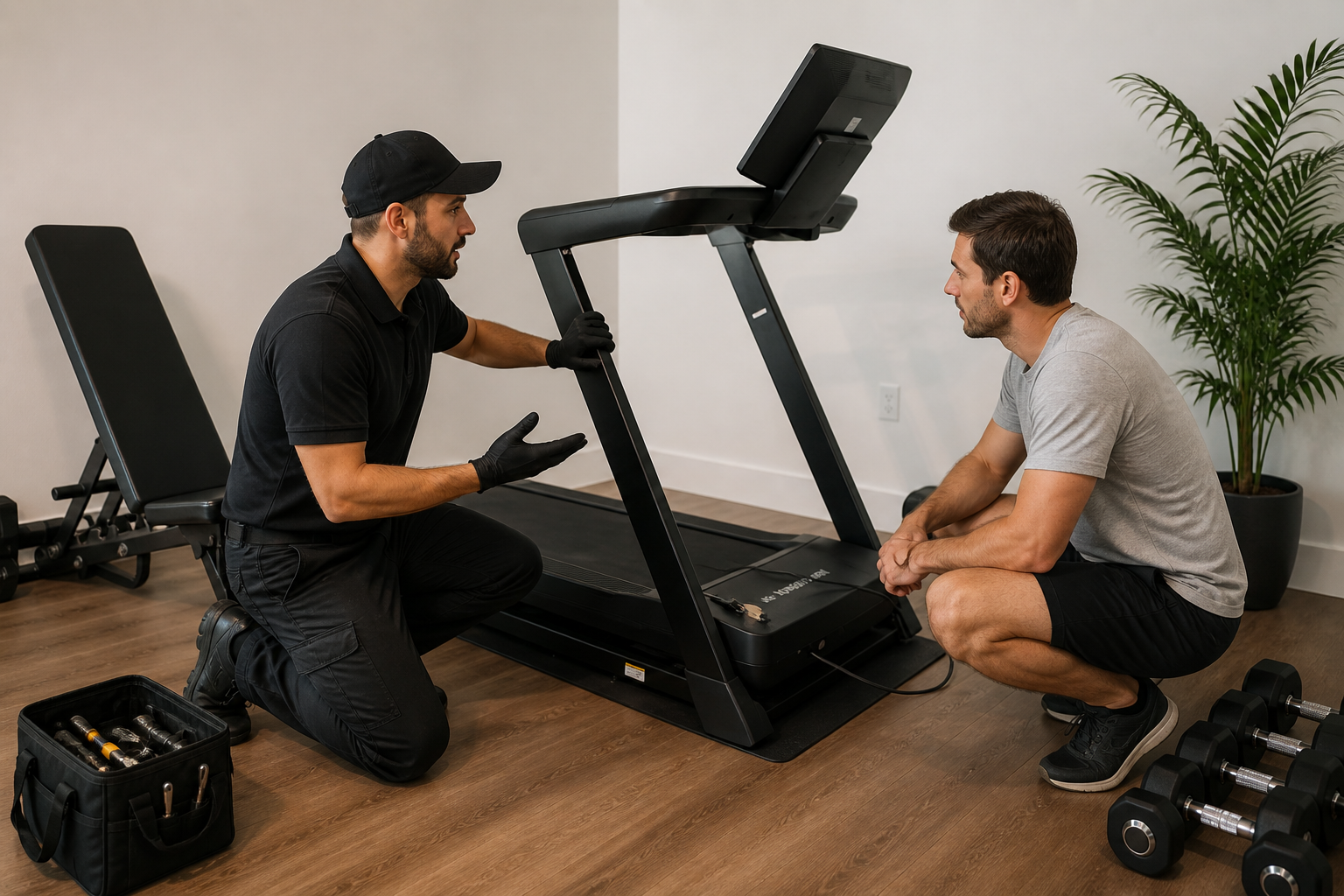

2EZ TEK repairs most major residential and commercial fitness equipment brands, including Life Fitness, Precor, Matrix, Cybex, Technogym, NordicTrack, Bowflex, TRUE Fitness, StairMaster, Schwinn, Nautilus, and many others. If you have a treadmill, elliptical, stationary bike, or strength machine sitting in your home and it has stopped working, there is a very good chance we can fix it regardless of the brand on the frame.
The Full Answer
The brands we service fall into two general categories: commercial-grade equipment and consumer-grade equipment. Commercial brands like Life Fitness, Precor, Matrix, Cybex, Technogym, and TRUE Fitness are built with heavier components, higher-duty motors, and more sophisticated electronics. These machines show up in gyms, but they also end up in a lot of Dallas Fort Worth homes when someone buys a used unit off a gym liquidation or invests in a high-end home setup. Repairing them requires familiarity with commercial motor control boards, incline actuator systems, and proprietary console wiring. These are not machines you want a general handyman guessing at.
Consumer brands like NordicTrack, Bowflex, Schwinn, and Nautilus are what most homeowners have in the guest room or garage. These machines use components like walking belts, drive motors, reed switches, tension rollers, and resistance magnets that we work on constantly. The parts are more widely available, but the diagnostics still require someone who knows how to read motor control board error codes, test flywheel sensors, and identify whether the problem is electrical or mechanical. A squeaking NordicTrack treadmill and a dead Bowflex elliptical both look simple from the outside and can both have several possible causes that need to be ruled out in order.
StairMaster and similar stair climber or stepper machines are in their own category because they have unique drive systems and step linkage assemblies that wear differently than treadmills or ellipticals. We service these as well, including both the older commercial StairMaster units and newer residential steppers. The short version is that if it plugs into a wall and you exercise on it, we have almost certainly worked on something very similar to what you own.
Related Problems to Watch For
- Walking belt slipping or hesitating: This is one of the most common issues across all treadmill brands. It usually points to a worn walking belt, a failing drive motor, or a motor control board that is not delivering consistent voltage. Brand does not matter much here. The symptom shows up on NordicTrack and Life Fitness alike.
- Console not powering on: A dead display can mean a failed motor control board, a blown fuse, a bad power supply, or a loose harness connection. This is brand-specific in terms of parts, but the diagnostic process is similar across machines.
- Incline not moving or stuck at an angle: The incline actuator is a motorized screw drive that lifts the front of the treadmill. These wear out, strip internally, or lose their limit switch signal. Precor and Life Fitness units have more robust actuators, but consumer brands can have these fail within a few years of regular use.
- Elliptical resistance not changing: On magnetic resistance ellipticals, the resistance magnet or its control circuit is usually the cause. On older eddy current machines, the motor driving the magnet position can fail. Schwinn, Nautilus, and Bowflex ellipticals all use variations of this system.
- Grinding or clicking noise during use: This often comes from a worn flywheel bearing, a loose tension roller, or a drive belt that has started to fray. Ignoring this usually leads to a more expensive repair later.
- Error codes on the console: Most modern machines from NordicTrack, Life Fitness, and Precor will display error codes when a sensor or component fails. These codes are useful but can be misleading without the right diagnostic tools and service documentation.
What This Repair Actually Involves
- Brand and model identification: Before anything else, we confirm the exact model number. Two machines from the same brand can use completely different motor control boards, walking belts, and drive motors. The model number is usually on a sticker under the motor hood or on the rear frame. This step determines what parts and service documentation apply.
- Visual and operational inspection: We run the machine through its functions, listen for abnormal sounds, check belt tracking and tension, inspect the drive motor brushes if applicable, and look for burn marks or corrosion on the motor control board. A lot of problems reveal themselves before we even pull a component.
- Electrical diagnostics: Using a multimeter and, where applicable, manufacturer diagnostic modes, we test voltage at the motor control board, check the reed switch signal from the flywheel or roller, and verify that the console is sending correct commands. This separates electrical failures from mechanical ones.
- Component replacement or adjustment: Once the failed component is confirmed, we replace or rebuild it. This might mean installing a new walking belt and lubricating the deck, replacing a motor control board, swapping a resistance magnet assembly, or rebuilding an incline actuator. We use OEM or equivalent-spec parts wherever possible.
- Post-repair testing: After the repair, we run the machine through a full range of speeds, inclines, and resistance levels to confirm the fix held and that no secondary issues were triggered by the original failure.
When to DIY vs. Call a Technician
There are a few things homeowners can safely handle on their own. Lubricating a treadmill walking belt with silicone lubricant is straightforward if your machine has a center access point and the manufacturer recommends it. Tightening a loose walking belt using the rear roller adjustment bolts is also manageable if you follow the machine's manual and make small adjustments. Cleaning dust and debris from around the motor area is something you should do regularly and does not require any technical skill.
Anything involving the motor control board, drive motor, incline actuator, or internal wiring is worth having a technician handle. These components carry line voltage and can cause injury if tested or replaced incorrectly. Misdiagnosing an electrical fault and replacing the wrong part is also a fast way to spend more money than a service call would have cost. If your machine is throwing error codes, making grinding noises, or simply will not power on, a technician visit will almost always be faster and cheaper than working through it yourself.
More Questions Customers Ask
Do you carry parts for older or discontinued fitness equipment models?
We source parts for a wide range of machines, including older models that manufacturers no longer actively support. Some components like motor control boards and walking belts have aftermarket equivalents that meet or exceed OEM specs. For very old machines, we will tell you upfront if parts are unavailable or if the repair cost does not make financial sense compared to replacement. We would rather give you an honest answer than take your money on a repair that will not last.
Can you repair equipment that is still under manufacturer warranty?
If your machine is under an active manufacturer warranty, you should contact the manufacturer first because third-party repairs can sometimes void that coverage. However, many warranties are limited in scope and expire quickly on consumer-grade machines. Once the warranty period has passed, or if the warranty does not cover labor, we are a straightforward option for getting the machine fixed without waiting weeks for a manufacturer service appointment.
Get This Fixed in Dallas Fort Worth
2EZ TEK serves residential customers across Dallas Fort Worth, and we know that many homeowners have been turned away by repair companies that only want commercial gym accounts. We actively take residential calls, and in most cases we can get to you within the same week. Reach out to us with your equipment brand, model number, and a description of the problem and we will get your machine back in working order.