
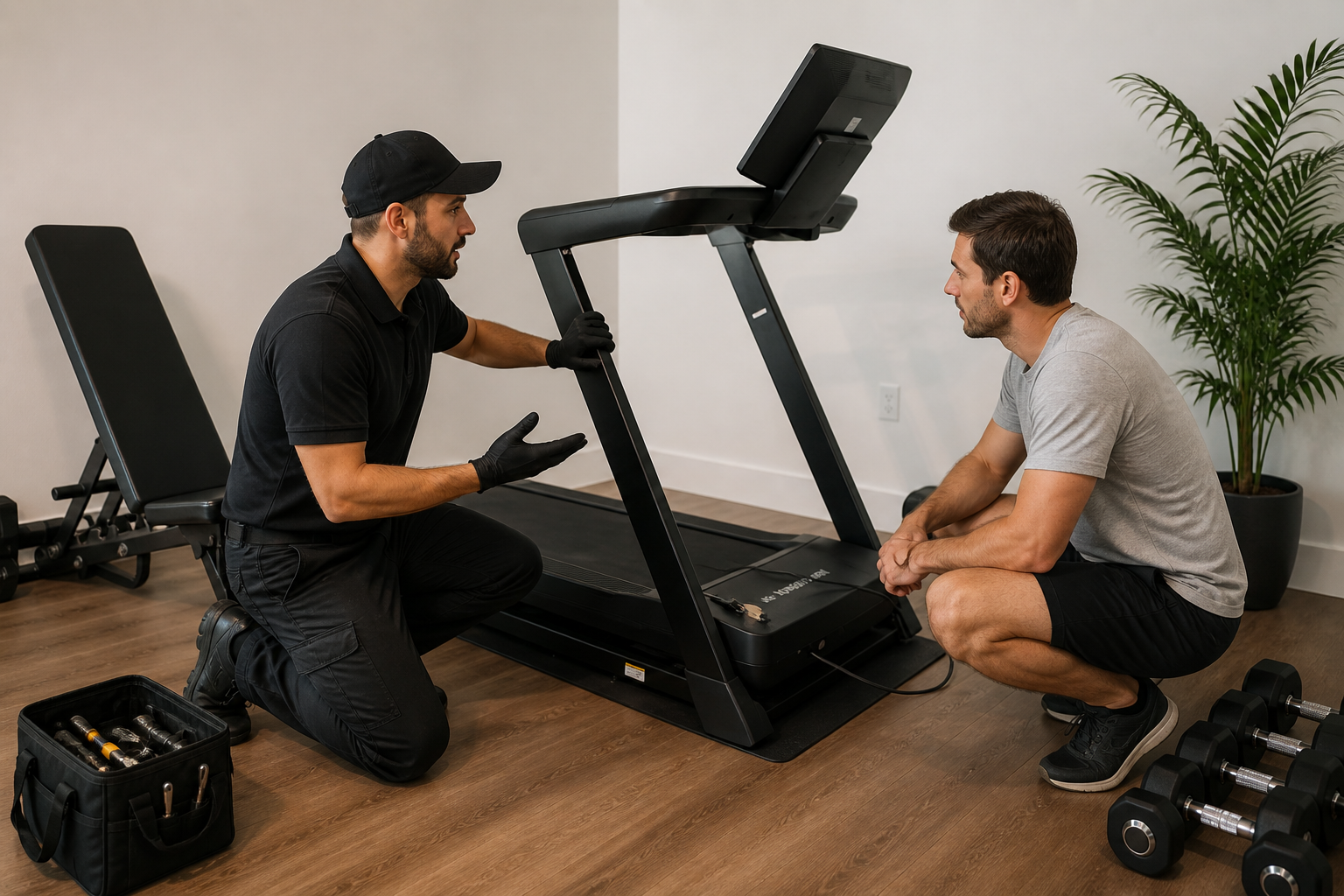

Your treadmill or elliptical needs regular maintenance even when it feels fine because internal components like the walking belt, drive motor, and tension rollers wear down gradually and silently. By the time you notice a problem, the damage is usually already done. Preventive maintenance catches deterioration early, before a worn belt destroys a motor control board or a dry bearing seizes a flywheel.
The Full Answer
Most treadmill and elliptical failures do not happen suddenly out of nowhere. They build up over months of use. The walking belt on a treadmill, for example, stretches and thins with every session. As it loses thickness, it creates more friction against the deck underneath. That extra friction forces the drive motor to work harder than it was designed to, pulling more current and generating more heat. The motor control board, which regulates power to the motor, starts absorbing that stress. By the time the belt feels sluggish or the motor smells hot, the board may already be damaged. A belt replacement that costs a fraction of a board replacement could have prevented the whole situation.
On ellipticals, the wear patterns are different but just as predictable. The resistance magnet and flywheel assembly accumulate dust and debris over time, which affects how smoothly resistance changes. The incline actuator on machines with adjustable ramp angles can develop play in the linkage, causing erratic incline behavior or complete actuator failure. Pedal arm pivot points and crank bearings dry out and develop noise or wobble that puts stress on the frame welds. None of these things feel dramatic at first. The machine still works. But the components are counting down.
The reed switch, which is the small magnetic sensor that reads your speed on most treadmills, is another good example. It sits near the front roller and reads a magnet attached to the roller shaft. When it gets dirty or slightly misaligned, the console starts showing erratic speed readings or no reading at all. Homeowners often assume the console is broken and start shopping for a replacement machine. In most cases, cleaning or repositioning the reed switch takes about ten minutes. Regular maintenance catches that kind of thing before it causes unnecessary panic or expense.
Related Problems to Watch For
- Belt slipping or hesitating under load: This usually means the walking belt needs lubrication or tension adjustment. Left alone, it accelerates wear on both the belt and the drive motor.
- Burning smell during or after use: Often a sign of excessive belt-to-deck friction or a motor running too hot. This is one of the clearest warnings that maintenance is overdue.
- Console reading speed or resistance incorrectly: A dirty or misaligned reed switch on treadmills, or a faulty resistance sensor on ellipticals, can make the machine feel unreliable even when mechanically it is mostly fine.
- Squeaking or grinding from the front or rear roller: Roller bearings dry out over time. Once they start making noise, they are close to failing. A seized roller can shred a walking belt in minutes.
- Incline that moves slowly or stops mid-adjustment: The incline actuator motor and drive screw need to be clean and properly lubricated. Neglected actuators wear out faster and are one of the more expensive components to replace.
- Elliptical pedals that feel uneven or wobbly: Loose or worn crank arm hardware and pivot bushings create uneven motion that puts asymmetric stress on the frame and drive train over time.
What This Repair Actually Involves
- Visual and mechanical inspection: A technician starts by checking the walking belt for wear, cracking, and proper tracking. On ellipticals, the flywheel, resistance magnet gap, and pedal arm hardware all get checked for play, corrosion, or debris buildup. This takes a trained eye because some wear patterns are subtle.
- Belt lubrication and tension adjustment: On treadmills, the underside of the walking belt gets lubricated with silicone-based lubricant appropriate for the deck material. Belt tension is then measured and adjusted at the rear roller bolts so the belt tracks centered and does not slip under body weight.
- Drive system check: The drive motor brushes (on brushed motors), motor control board connections, and drive belt are inspected for wear and proper tension. Loose or cracked drive belts are replaced before they snap and damage surrounding components.
- Reed switch cleaning and calibration: The speed sensor reed switch gets cleaned and its gap to the roller magnet gets verified. Console calibration is checked against actual belt speed where possible.
- Incline and resistance system test: The incline actuator is cycled through its full range and checked for smooth, consistent movement. On ellipticals, resistance levels are tested at multiple settings to confirm the magnet is responding correctly to the console commands.
When to DIY vs. Call a Technician
There are a few things homeowners can reasonably handle on their own. Wiping down the machine after use, keeping the area around it vacuumed so dust does not get pulled into the motor, and applying silicone lubricant to the walking belt every three to six months are all reasonable DIY tasks. Most treadmill manufacturers include lubrication instructions in the manual, and the process is straightforward if you follow them. Checking that the walking belt is tracking centered and not drifting to one side is also something you can monitor visually during use.
Beyond that, it is worth calling a technician. Adjusting belt tension incorrectly can cause the belt to slip, overheat, or track off the deck entirely. Opening up the motor housing or motor control board area without knowing what you are looking at creates real electrical risk. Incline actuator adjustments involve mechanical linkage that can bind or break if reassembled wrong. A professional maintenance visit once a year, or every 200 to 300 hours of use, is the practical standard for residential equipment. It costs far less than a motor control board replacement or a walking belt that has worn through to the deck.
More Questions Customers Ask
How often should I have my treadmill professionally serviced?
For most residential treadmills used three to five times per week, once a year is a reasonable baseline. If multiple people in the household use the machine regularly, or if it runs for longer sessions, every six months is a better target. Ellipticals generally need less frequent attention than treadmills because they have no walking belt or deck friction, but the flywheel bearings, resistance system, and pivot hardware still benefit from an annual inspection.
Can skipping maintenance void my warranty?
It depends on the manufacturer, but many treadmill and elliptical warranties include language requiring the owner to perform routine maintenance as outlined in the manual. If a motor burns out and the technician finds a belt that has never been lubricated and is worn through, the manufacturer may deny the warranty claim on the grounds that the failure resulted from neglect. Keeping a simple log of when you lubricated the belt or had a service visit gives you documentation if a warranty situation ever comes up.
Get This Fixed in Dallas Fort Worth
2EZ TEK provides residential fitness equipment maintenance throughout the Dallas Fort Worth area, and we know that homeowners often have a harder time finding service than gyms and facilities do. Many repair companies in DFW only want commercial accounts, which leaves people with a treadmill in the guest room or an elliptical in the garage without good options. We actively serve residential clients and can usually schedule a maintenance visit within the same week. Reach out to 2EZ TEK and keep your equipment running safely before a small issue turns into a costly repair.